Independent music radio dedicated to instrumental and country sounds from around the world. Here, style matters more than language, and music travels across cultures
Un détenu s’est évadé d’une prison suédoise pour faire soigner une rage de dent avant de se rendre à la police, et a vu sa peine prolongée d’une journée.
funny dentist
Le prisonnier s’était échappé début novembre de la prison de Oestragaard dans le sud-ouest de la Suède, deux jours avant la date de la fin de sa peine, “parce qu’il avait mal aux dents et voulait aller chez le dentiste”, ont indiqué des responsables de la prison. “En sortant du dentiste il s’est rendu à la police”, selon la même source.
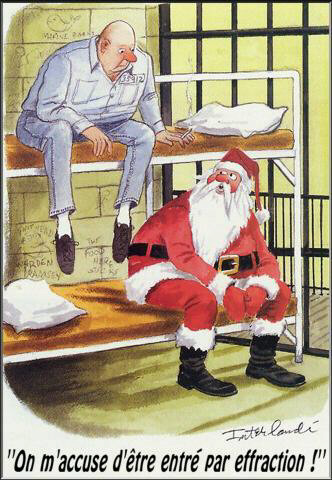
père noel en prison
L’homme de 51 ans s’était plaint de maux de dents auprès des responsables de la prison quatre jours avant son évasion de cette prison aux mesures de sécurité peu strictes. “Tout mon visage était totalement enflé”, a expliqué ce prisonnier au quotidien suédois Dagens Nyheter. “A la fin je ne pouvais plus le supporter”, a-t-il ajouté.
Sa peine, d’un mois de détention à l’origine, a été prolongée de 24 heures, les responsables de la prison ayant décidé de décompter le jour de l’incident du temps purgé en prison. Le détenu, qui a quitté la prison depuis, a expliqué au journal suédois qu’il était avant tout content de s’être débarrassé de sa rage de dent. “Maintenant il me reste à payer la note du dentiste”, a-t-il conclu.
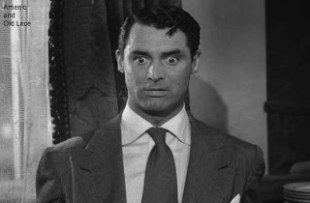
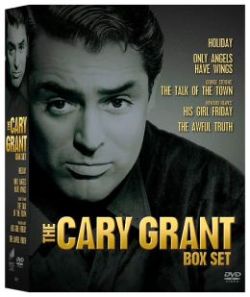
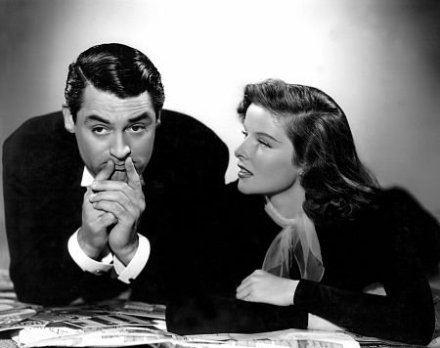
Cary Grant (born Archibald Alexander Leach; January 18, 1904 – November 29, 1986) was an English stage and Hollywood film actor who became an American citizen in 1942. Known for his transatlantic accent, debonair demeanor and “dashing good looks”, Grant is considered one of classic Hollywood‘s definitive leading men.
Archibald Alexander Leach was born at 15 Hughenden Road, Horfield, Bristol, England, to Elsie Maria (née Kingdon) Leach (1877–1973) and Elias James Leach (1873–1935). An only child, Leach had an unhappy upbringing, attending Bishop Road Primary School.
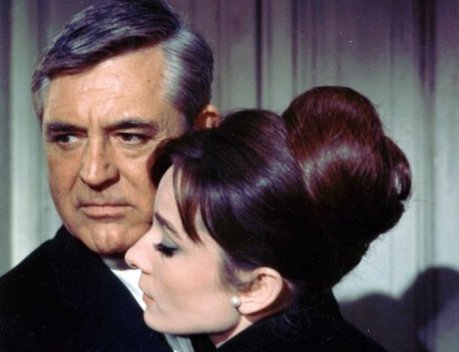
CARY GRANT WITH AUDREY HEPBURN
His mother had suffered from clinical depression since the death of a previous child. Her husband placed her in a mental institution and told his 9-year-old son only that she had gone away on a “long holiday”. Believing she was dead, Leach did not learn otherwise until he was 31 and discovered her alive in a care facility. When Leach was 10, his father abandoned him after remarrying and having a baby with his new young wife.
Leach was expelled from the Fairfield Grammar School in Bristol in 1918. After joining the “Bob Pender Stage Troupe”, Leach performed as a stilt walker and traveled with the group to the United States in 1920 at the age of 16 on the RMS Olympic, on a two-year tour of the country. He was processed at Ellis Island on July 28, 1920.
When the troupe returned to the UK, he decided to stay in the U.S. and continue his stage career. During this time, he became a part of thevaudeville world and toured with Parker, Rand, and Leach.
Still using his birth name, he performed on the stage at The Muny in St. Louis,Missouri, in such shows as Irene (1931), Music in May (1931), Nina Rosa (1931), Rio Rita (1931), Street Singer (1931), The Three Musketeers (1931), and Wonderful Night (1931). Leach’s experience on stage as a stilt walker, acrobat, juggler, and mime taught him “phenomenal physical grace and exquisite comic timing” and the value of teamwork, skills which would benefit him in Hollywood.
Leach became a naturalized United States citizen on June 26, 1942, at which time he also legally changed his name from “Archibald Alexander Leach” to “Cary Grant”.
After appearing in several musicals on Broadway under the name Archie Leach, Leach went to Hollywood in 1931. When told to change his name, he proposed “Cary Lockwood”, the name of the character he had played in the Broadway show Nikki, based upon the recent film The Last Flight.
He signed with Paramount Pictures, where studio bosses decided that the name “Cary” was acceptable but that “Lockwood” was too similar to another actor’s surname. Paramount gave their new actor a list of surnames to choose from, and he selected “Grant” because the initials C and G had already proved lucky for Clark Gable and Gary Cooper, two of Hollywood’s biggest film stars.
I’m No Angel was a tremendous financial success and, along with She Done Him Wrong, which was nominated for an Academy Award for Best Picture, saved Paramount from bankruptcy. Paramount put Grant in a series of unsuccessful films until 1936, when he signed with Columbia Pictures. His first major comedy hit was when he was loaned to Hal Roach‘s studio for the 1937 Topper (which was distributed by MGM).
The Awful Truth (1937) was a pivotal film in Grant’s career, establishing for him a screen persona as a sophisticated light comedy leading man. As Grant later wrote, “I pretended to be somebody I wanted to be and I finally became that person. Or he became me. Or we met at some point.” Grant is said to have based his characterization in The Awful Truth on the mannerisms and intonations of the film’s director, Leo McCarey, whom he resembled physically. As writer/director Peter Bogdanovich noted, “After The Awful Truth, when it came to light comedy, there was Cary Grant and then everyone else was an also-ran.”
Grant remained one of Hollywood’s top box-office attractions for almost 30 years. Howard Hawks said that Grant was “so far the best that there isn’t anybody to be compared to him”.[15]David Thomson called him “the best and most important actor in the history of the cinema“.
Grant was a favorite of Hitchcock, who called him “the only actor I ever loved in my whole life”.
Besides Suspicion, Grant appeared in the Hitchcock classics Notorious (1946), To Catch a Thief(1955), and North by Northwest (1959). Biographer Patrick McGilligan wrote that in 1965 Hitchcock asked Grant to star in Torn Curtain (1966) only to learn that Grant had decided to retire after making one more film, Walk, Don’t Run (1966);
Paul Newman was cast instead, oppositeJulie Andrews. Producers Broccoli and Saltzman originally sought Cary Grant for the role of James Bond in Dr. No but discarded the idea as Grant would be committed to only one feature film and the producers decided to go after someone who could be part of a franchise.
Grant was the first actor to “go independent” by not renewing his studio contract, effectively leaving the studio system, which almost completely controlled what an actor could or could not do. In this way, Grant was able to control every aspect of his career, at the risk of not working because no particular studio had an interest in his career long term.
He decided which films he was going to appear in, often had personal choice of directors and co-stars, and at times even negotiated a share of the gross revenue, something uncommon at the time. Grant received more than $700,000 for his 10% of the gross for To Catch a Thief while Hitchcock received less than $50,000 for directing and producing it.
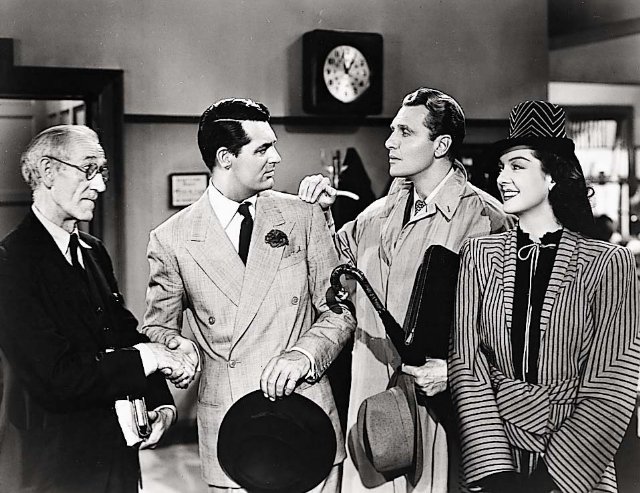
Grant poked fun at himself with statements such as “Everyone wants to be Cary Grant—even I want to be Cary Grant”, and in ad-lib lines—such as in the film His Girl Friday, saying, “I never had so much fun since Archie Leach died”. In Arsenic and Old Lace (1944), a gravestone is seen bearing the name Archie Leach. According to a famous story now believed to be apocryphal, after seeing a telegram from a magazine editor to his agent asking “How old Cary Grant?” Grant reportedly responded with “Old Cary Grant fine. How you?
Cary Grant retired from the screen at 62 when his daughter Jennifer was born, in order to focus on bringing her up and to provide a sense of permanency and stability in her life.
While bringing up his daughter, he archived artifacts of her childhood and adolescence in a bank-quality room-sized vault he had installed in the house.
His daughter attributed this meticulous collection to the fact that artifacts of his own childhood had been destroyed during the Luftwaffe’s bombing of Bristol in the Second World War (an event that also claimed the lives of his uncle, aunt, and cousin as well as the cousin’s husband and grandson), and he may have wanted to prevent her from experiencing a similar loss.
Although Grant had retired from the screen, he remained active.
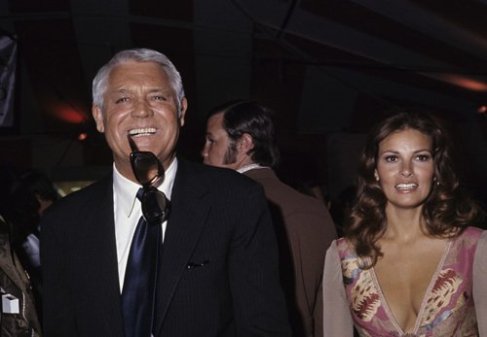
CARY GRANT – MARTIN LANDAU
In the late 1960s, he accepted a position on the board of directors at Fabergé. By all accounts this position was not honorary, as some had assumed; Grant regularly attended meetings and his mere appearance at a product launch would almost certainly guarantee its success. The position also permitted use of a private plane, which Grant could use to fly to see his daughter wherever her mother, Dyan Cannon, was working.
He later joined the boards of Hollywood Park, the Academy of Magical Arts (The Magic Castle, Hollywood, California), Western Airlines (now Delta Air Lines), andMGM.
He was a keen motoring enthusiast and, like many other Hollywood stars of the era, owned many notable cars. One of the first he owned was a 1929 Cadillac Cabriolet. His love of Cadillacs never waned and he later purchased a Cadillac Eldorado Biarritz. Other cars that he owned included an MG Magnette and a Sunbeam Alpine series one roadster.
In the last few years of his life, Grant undertook tours of the United States in a one-man show, A Conversation with Cary Grant, in which he would show clips from his films and answer audience questions. Grant was preparing for a performance at the Adler Theatre in Davenport, Iowa, on the afternoon of November 29, 1986, when he sustained a cerebral hemorrhage (he had previously suffered a stroke in October 1984). His wife did not know what was going on and she went to a local pharmacy to get aspirin. He died at 11:22 p.m. in St. Luke’s Hospital at the age of 82.
The bulk of his estate, worth millions of dollars, went to his fifth wife, Barbara Harris, and his daughter, Jennifer Grant
In 2001, a statue of Grant was erected in Millennium Square, a regenerated area next to Bristol Harbour in his city of birth, Bristol.
In November 2005, Grant came in first in the “The 50 Greatest Movie Stars of All Time” list by Premiere magazine. Richard Schickel, the film critic, said about Grant: “He’s the best star actor there ever was in the movies.
Beaucoup d’articles ont déjà été écrits sur la question, et plutôt que de vous noyez sous une liste d’applications au final pas si utiles que ça, je vous présente aujourd’hui mes applications préférées, testées et approuvées, celles que j’utilise systématiquement quand je pars en voyage. Le plus ? Elles sont toutes gratuites ! ——— Si […]
La technique que je propose dans cette vidéo est à utiliser lorsque nous avons eu un coup dur et que nous ressentons que nous sommes en train de basculer dans un puits de tristesse ou encore lorsque nous sommes déstabilisés par une période de stress intense.
Cette façon de faire peut aussi être utilisée lorsque nous vivons des minuscules frustrations qui répétées tout au long de la journée nous font perdre notre bonne humeur et notre énergie et nous décentre complètement de la direction que nous désirons donner à notre journée.
Elle est aussi très efficace pour reprogrammer nos autoroutes émotionnelles, nos « patterns émotionnels », comme je l’explique dans ma vidéo. Il faut comprendre que c’est notre cerveau qui crée les émotions en activant différents circuits électriques et en libérant des hormones qui vont colorer notre état interne. Plus nous vivons une émotion à répétition et plus nous renforçons son circuit, plus celle-ci devient prédominante et plus elle se transforme en humeur puis en caractère et en trait de personnalité.
Si nos autoroutes sont surtout celles qui véhiculent le cortisol, nous serons davantage soit sur la défensive ou encore agressif et nous aurons probablement l’étiquette d’être « bougon » ou encore « soupe au lait ». Nous aurions avantage à utiliser cette technique rapidement.
Attention, je ne suis pas en train de dire qu’il faille refouler nos émotions aversives (négatives ou déplaisantes) et privilégier les émotions appétitives (positives ou plaisantes), celles que nous aimons vivre. Toutes nos émotions sont importantes, elles sont des messagères. Il est bon de savoir les raisons pour lesquelles nous vivons ces émotions et il ne faudrait pas les banaliser ou encore les balayer sous le tapis.
J’aime beaucoup la métaphore du camembert à cet effet. « Les émotions c’est un peu comme du camembert, si nous les mettons dans l’armoire en croyant se libérer, cela prendra quelques temps pour que toutes les pièces de la maison embaument de son odeur. »
Une émotion doit être ressentie et comprise avant tout, puis libérée. Nous croyons que nous n’avons que deux choix : exprimer nos émotions ou les refouler, les cacher pour qu’elles ne dérangent personne. Nous avons aussi le choix « d’être avec », ce qui veut dire les écouter même lorsqu’elles murmurent et les valider, leur donner du sens pour mieux comprendre ce qui se passe en nous. Pour avoir une chronique complète sur le sujet c’est ici Comment baisser sa réactivité grâce aux neurones inhibiteurs
Car effectivement nous avons tendance à chercher l’origine de nos émotions à l’extérieur de nous et ainsi abandonner notre pouvoir personnel et rester à la merci des circonstances. Mais en fait, nos émotions viennent toujours de nous, du sens que l’on donne à l’évènement. C’est un peu comme si nous avions un centre d’analyse où il y avait une énorme bibliothèque dans notre cerveau, et chaque sensation y était répertorié et associé à une émotion ( voir article à ce sujet ) Souhaiteriez-vous cocréer avec votre coeur et votre cerveau?).
Ce qui veut dire que pour quelqu’un, la vue et l’odeur d’un biscuit à l’avoine suscite un apaisement et sentiment de douceur car sa grand-mère l’accueillait au retour de l’école avec ces biscuits frais sortis du four. Ici je simplifie au maximum mais ce centre détient les associations que notre cerveau a élaborées tout au long de notre vie.
Prenons l’exemple de Colette qui revient de vacances. Elle croise le regard de son directeur lors d’un évènement, mais il ne lui fait aucun sourire. Tout de suite le cerveau de Colette s’active, elle ressent une émotion d’inconfort, puis de la confusion, ce qui la porte à se poser encore plus de questions car le cerveau de Colette associe ce « non sourire » à un manque de respect, ce qui lui fait libérer encore plus de cortisol. Elle se demande: mais quelle est la raison pour laquelle il ne m’a pas souri? Peut-être était-il trop occupé? Mais peut-être aussi s’est-il aperçu pendant mon absence que je ne suis pas importante car ne pas sourire à quelqu’un, c’est de lui dire qu’il n’est pas important, qu’il n’a pas sa place dans le groupe. Peut-être a-t-il pris la décision de me renvoyer? Etc…
Si la libération de cortisol perdure c’est parce que nous l’encourageons avec nos pensées. Aussi tout dépend de comment le cerveau de Colette a hiérarchisé sa place dans la pyramide sociale de son milieu de travail et de l’influence de ses conditionnements passés et alors, , elle réagira d’une façon ou d’une autre. Ce ne sont pas toutes les personnes qui auraient réagi de la même façon à cette situation. Si vos désirez avoir plus d’informations sur la pyramide sociale c’et ici Profitez de l’été pour reprogrammer votre cerveau
En même temps la sérotonine que nous sécrétons par notre rang social inconscient est priorisé par tous car nous l’interprétons comme une question cruciale à notre survie.Colette aurait très bien pu se calmer simplement en se retirant du groupe, en s’assoyant pour être simplement dans son corps avec ses ressentis, en respirant à travers ceux-ci, en étant simplement à l’écoute de ses sensations corporelles jusqu’à ce qu’elles soient dissipées. Habituellement lorsque le mental se tait, c’est très rapide. Puis une fois calmée, elle irait trouver son directeur afin de vérifier ses doutes.
Par moment certaines situations nous causent beaucoup d’émotions et de pensées et nous nous sentons bloqués comme si nous étions incapables d’avancer. Nous ne savons pas comment vivre la situation et ainsi nos émotions aversives prennent beaucoup d’énergie et peuvent même nous faire basculer dans un état dépressif ou de grande colère ou de nervosité. Si nous comprenons ce qu’il nous arrive et que nous savons exactement ce dont nous avons besoin pour faire un lâcher prise et que nous désirons reprendre rapidement notre énergie, cette façon de faire est avantageuse pour nous. Mais attention elle ne doit surtout pas être utilisée comme une « aspirine » pour camoufler les symptômes si nous manquons de recul et de compréhension envers la situation.
Il est important de mémoriser, que toute émotion que l’on essaie de refouler est un peu comme si nous essayons de garder sous l’eau, un énorme ballon de plage. Cela demande beaucoup d’énergie et nous risquons de recevoir le ballon au visage, un jour ou l’autre, et cela sans avertissement. De plus, à réprimer nos émotions aversives, nous perdons en intensité sur nos émotions appétitives. Le but n’est pas d’éteindre notre feu émotionnel mais plutôt cocréer avec notre corps et notre système nerveux tout comme nous utilisons la méditation et la pratique de la cohérence cardiaque pour mieux se recentrer et avoir une plus grande tolérance à la frustration.
Voici un vidéo qui fait sourire
POUR CE FAIRE
Lorsque nous sourions ou rions, ainsi notre pression artérielle diminue, notre thorax se détend et nous respirons plus facilement. Notre cerveau libère des neurotransmetteurs essentiels comme :
• la sérotonine qui améliore l’humeur et les cycles du sommeil, suscite aussi le sentiment d’être respecté par les autres et nous donne de la fierté. C’est elle qui nous donne ce sentiment de paix, de bien-être et elle est présente en plus grande quantité dans notre tube digestif car elle y joue un rôle primordial.
• l’endorphine qui est décrite comme étant l’hormone du bonheur, elle provoque l’euphorie, elle est anxiolytique et revitalisante en plus d’être un antidouleur efficace.
Tout en respectant nos émotions, il est possible d’utiliser les moments où nous sommes au neutre, pour développer des autoroutes différentes de celles auxquelles nous sommes habitués et ainsi sortir de nos automatismes émotionnels ou encore des réponses naturelles de notre corps à la suite d’évènements difficiles.
Utilisons le corps pour déjouer notre cerveau et augmenter notre intelligence émotionnelle.
Nous pouvons déjouer notre cerveau des émotions (le cerveau limbique) et transformer nos émotions car elles sont avant tout des ressentis physiques interprétés par notre cerveau qui vient y associer une signification similaire à notre passé . C’est pour cette raison que les pratiques corporelles sont très efficaces pour modifier nos « patterns » émotionnels.
Utiliser le rire, c’est un soleil artificiel qui illumine notre quotidien. Si cette brillante lumière a suffisamment éclairé notre journée, nous nous endormons facilement comme un enfant car eux ont encore leurs cœurs d’enfant et ils rient beaucoup plus souvent que nous dans une journée. Le rire est un aimant. Avez-vous remarqué comme il est contagieux et comme nous sommes curieux de savoir ce qui fait rire nos voisins, nous souhaitons rire aussi à notre tour.
2. Aussi le rire tisse les liens. Nous aimons être en présence de personnes qui allègent notre journée par le rire. Il donne des vitamines, il est bon pour le corps et notre cerveau. Nous l’avons compris rapidement, car nous allons facilement vers ceux qui nous font rire.
3. Écouter une musique entraînante, chanter, danser, tous ces gestes illuminent notre journée, elle met de la lumière là où il en manque.
4. Pour penser à sourire et rire, dessinons-nous sur la main un bonhomme sourire et commençons à apprendre des blagues que nous pourrons raconter à nos proches. Sourire c’est rajeunir!
Some years ago, we made an organized tour to Sorrento, Italy. Why Sorrento? We knew that it was a beautiful small town. In 2016 its population was about 16609 inhabitants. Sorrento offered a nice way to make short excursions on one’s own to the nearby places like Capri, Vesuvius and Pompeii. We also visited Naples, but I did not shoot many photos from there and that is why I am not going to post any posts from there.
Although it has passed many years since our visit, it is still in our memory. Capri is an island, where You could visit once in the life time. Same words are valid also for Vesuvius and Pompeii. I could visit Pompeii once more, because I love history and it was full of awesome history.
Welcome to walk with us thru my photos in these three…
Suivez Lulu en Nouvelle Zelande / Follow Lulu in New Zealand
Vous avez tous vu les photos et vidéos, on est bien d’accord, le pays est un véritable trésor pour les yeux. Mais d’un autre côté j’ai finalement eu l’impression de passer 3 mois en territoire européen. Je m’explique
Voila le petit dernier encore en direct de Nouvelle Zélande. Dans quelques heures, je quitterai le territoire Kiwi après exactement 88 jours sur place.
Pour moi le bilan est mitigé, j’attendais peut etre trop de cette terre à l’autre bout du monde que finalement, il me semble qu’il m’a manqué un petit quelque chose. Je suis tiraillée entre la beauté et grandiosité des panoramas et le manque de dépaysement.
Vous avez tous vu les photos et vidéos, on est bien d’accord, le pays est un véritable trésor pour les yeux. Mais d’un autre côté j’ai finalement eu l’impression de passer 3 mois en territoire européen. Je m’explique!
Si le terme WHV ne vous dit rien et bien pour moi, c’est certainement le mot que j’ai le plus entendu ici.
Ce pays a un énorme besoin de main d’oeuvre et pour y remedier tout en gardant ses frontières fermés, il existe…
Acadia National park est une aire de loisirs de la côte Atlantique de 47 000 acres principalement sur l’île des monts déserts du Maine. Son paysage est marqué par des forêts, des plages rocheuses et des pics de granit érodés, le glacier comme Cadillac Mountain, point culminant de la côte est des États-Unis. Parmi la faune sont les orignaux, les ours, les baleines et les oiseaux de mer.
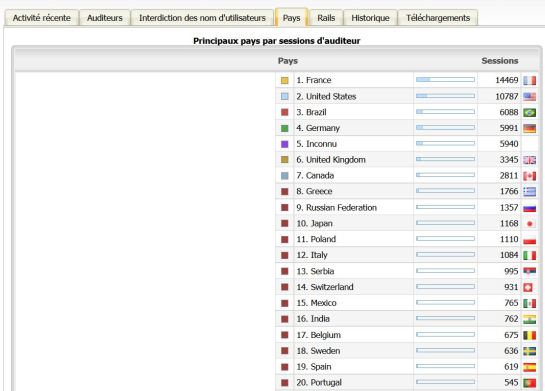
As we do ( from time to time ) we communicate to our readers and listeners, the last stats of our 2 webradios ( Internet radio Stations)
For February, we have just received the stats concerning “RadioSatellite” for February 2019
Images show us , listeners by country. ( Number of listeners )
Everyone of you will find his / her country on the list (hope that we have listeners in your country )
Comme nous le faisons, de temps en temps, nous vous communiquons les chiffres des stats concernant nos webradios( Radio en ligne sur internet )
Cette fois, ci, nous communiquons les chiffres de “RadioSatellite”
Les chiffres indiquent le nombre d’auditeurs / d’auditrices par pays.
Chacune / chacun d’entre vous, chers lecteurs, auditeurs, pourra retrouver son pays sur la liste ( En espérant que nous avons des auditeurs dans votre pays)
Scènes de ménages est un sitcom français , relatant des séquences de vie au quotidien de plusieurs ménages.
Les ménages sont divers et assez fantasques souvent.
Des couples de tous les âges, de toutes catégories sociales et culturelles.
De quoi brasser relativement large entre les couples vivant en zone urbaine
Et ceux vivant en zone rurale.
Scènes de ménages
Les séniors de la série : Huguette et Raymond.
Leur trait principal (commun ) qui les caractérise : Le scinisme ( sympa), la méchanceté gratuite envers leurs voisins, envers leurs entourage et même entre eux.
Raymond : Gendarme à la retraite s’ennuie. Huguette, son épouse : Femme au foyer passe son temps à taquiner son mari ( et réciproquement)
Huguette est une fan inconditionnelle d’un chanteur : Michael François.
Huguette & Raymond ont une fille : Caroline. Fille pour laquelle, ils n’ont aucun sentiment, pire, c’est presque de la destestation et moquerie qu’ils expriment lorsqu’ils parlent d’elle.
José et Liliane :
Un couple Quinquagénaire. Liliane est esthéticienne. José Fonctionnaire à la mairie.
Les premières saisons, Liliane poussait fortement son mari à se présenter aux élections municipales. Les campagnes et promos organisées par Liliane . L’impression ( et c’est la réalité ) que José se présente en candidat aux élections en tant que maire parce que c’est Liliane qui le veut.
En fait, nous voyons Liliane gérer toute sa campagne électorale ; José suivant sagement pas convaincu et pas réellement intéressé par le poste.
Le slogan de la campagne électorale : Osez José
Sa passion : Le foot. Assez paresseux, il ne rate aucune occasion pour rentrer plus tôt à la maison. Son épouse le pousse assez souvent de repartir travailler.
Ils ont un enfant : Manu. Le point faible de Liliane. Manu qui vit en chine pour son boulot.
La plupart du temps, José , gauche et maladroit blesse ses amis aussi bien que sa femme sans pour autant réaliser l’impact de ses paroles et gestes.
Cédric et Marion : Un couple fantasque
Cédric, gestionnaire, salarié durant les premiers épisodes. Par la suite, il va connaitre le chômage. Radin,
En revanche, sa compagne ( qui devient son épouse par la suite) s’auto proclame « femme d’affaires » et recrute des stagiaires à la pelle qu’elle (mal)traite comme des soldats à sa disposition.
Cédric et Marion se considèrent très beaux, très intelligents et pensent que les autres les jalousent. (ce qui n’est nullement le cas : quant à l’intelligence notamment )
Fabien et Emma : Le couple citadin qui a décidé de s’installer à la campagne.
Emma :bricoleuse au caractère assez “cash”.
D’ailleurs, elle occupe un poste chez Bricoflex. Côté culture, ce n’est pas son fort. Même si parfois elle essaie de faire des efforts pour donner la réplique à son conjoint.
Justement Fabien : Fier d’être professeur « agrégé ». Il n’est même pas bricoleur du dimanche. Plus posé, il lui arrive souvent d’agir bizarrement notamment lorsqu’il s’agit de combattre ses peurs et phobies. Peur de tout. Il suffit qu’il visionne un film d’horreur en soirée et ce, « malgré lui », c’est parti pour une nuit blanche.
Ils ont transformé leur maison en maison d’hôte ( ou gîte ) mais étant amateurs dans ce domaine, ce n’est pas trop leur fort « la fidélisation des clients »
Philippe et Camille
Philippe est Pharmacien. Bourgeois à la tête de sa pharmacie qui engendre des recettes énormes. Philippe ne s’en cache pas. Il répète à qui veut qu’il est pharmacien. Il considère qu’il a réussi sa vie « puisqu’il est pharmacien » . Beaucoup plus âgé que Camille , Philippe vit dans l’angoisse que Camille le quitte. A cause de son âge justement
Philippe a 2 enfants issus d’une première union avec Isabelle : Ulysse et Camille.
Ulysse paresseux et vivant aux crochets de son père.
Camille : Professeur de Yoga. Assez ouverte ( voire trop parfois ). Elle reprend ses histoires amoureuses de nombreuses fois durant ses conversations avec ses invités. Ce qui choque et fait peur à Philippe.
A préciser que Camille essaie d’imposer à Philippe un régime alimentaire drastique.
Léo et Leslie : Le couple Geek
Lelo et Leslie Scènes de ménages
C’est le dernier né des couples de « scènes de ménages » : Ils viennent remplacer le duo ( Marion et Fabien )
Léo et Leslie sont un couple assez « nerd » (geek ) passionnés de nouvelles technologies.
Photos : M6, Le parisien, Google, programme tv, antenne réunion, Paris Match, Ouest France etc… diverses autres sources.
Charles Eugene “Pat” Boone (born June 1, 1934) is an American singer, composer, actor, writer, television personality, motivational speaker, and spokesman. He was a successful pop singer in the United States during the 1950s and early 1960s.
pat Boone
He sold more than 45 million records, had 38 top-40 hits, and appeared in more than 12 Hollywood films.
According to Billboard, Boone was the second-biggest charting artist of the late 1950s, behind only Elvis Presley, and was ranked at No. 9 in its listing of the Top 100 Top 40 Artists 1955–1995.
Until the 2010s, Boone held the Billboard record for spending 220 consecutive weeks on the charts with one or more songs each week.
At the age of 23, he began hosting a half-hour ABC variety television series, The Pat Boone Chevy Showroom, which aired for 115 episodes (1957–1960). Many musical performers, including Edie Adams, Andy Williams, Pearl Bailey, and Johnny Mathis, made appearances on the show. His cover versions of rhythm and blues hits had a noticeable effect on the development of the broad popularity of rock and roll. Elvis Presley was the opening act for a 1955 Pat Boone show in Cleveland, Ohio.
As an author, Boone had a number-one bestseller in the 1950s (Twixt Twelve and Twenty, Prentice-Hall). In the 1960s, he focused on gospel music and is a member of the Gospel Music Hall of Fame. He continues to perform and speak as a motivational speaker, a television personality, and a conservative political commentator.
Boone was born Charles Eugene Boone on June 1, 1934, in Jacksonville, Florida, the son of Margaret Virginia (Pritchard) and Archie Altman Boone. Boone was reared primarily in Nashville, Tennessee, a place he still visits. His family moved to Nashville from Florida when Boone was two years old. He attended and graduated in 1952 from David Lipscomb High School in Nashville. His younger brother, whose professional name is Nick Todd, was also a pop singer in the 1950s and is now a church music leader.
Pat Boone
In a 2007 interview on The 700 Club, Boone claimed that he is the great-great-great-great grandson of the American pioneer Daniel Boone.
He is a cousin of two stars of Western television series: Richard Boone of CBS’s Have Gun – Will Travel and Randy Boone, of NBC’s The Virginian and CBS’s Cimarron Strip.[citation needed] Research done a few years ago by The Boone Society found that Pat and his siblings are not biological descendants of Daniel Boone, nor of any of Daniel’s brothers.
Pat’s siblings were notified and have acknowledged that the research done by The Boone Society is true.
In November 1953, when he was 19 years old, Boone married Shirley Lee Foley, daughter of country music great Red Foley and his wife, singer Judy Martin. They have four daughters: Cheryl Lynn (better known as Cherry), Linda Lee, Deborah Ann (better known as Debby), and Laura Gene. Starting in the late 1950s, Boone and his family were residents of Leonia, New Jersey.
In college, he primarily attended David Lipscomb College, later Lipscomb University, in Nashville. He graduated in 1958 from Columbia University School of General Studies magna cum laude[7] and also attended North Texas State University, now known as the University of North Texas, in Denton, Texas.
Boone began his career by performing in Nashville’s Centennial Park
He began recording in 1954 for Republic Records (not to be confused with the current label with that name), and by 1955, for Dot Records.
His 1955 version of Fats Domino’s “Ain’t That a Shame” was a hit. This set the stage for the early part of Boone’s career, which focused on covering R&B songs by black artists for a white American market.
Randy Wood, the owner of Dot, had issued an R&B single by the Griffin Brothers in 1951 called “Tra La La-a”—a different song from the later LaVern Baker one—and he was keen to put out another version after the original had failed. This became the B side of the first Boone single “Two Hearts Two Kisses”, originally by the Charms – whose “Hearts Of Stone” had been covered by the label’s Fontane Sisters.
Once the Boone version was in the shops, it spawned more covers by the Crew-Cuts, Doris Day, and Frank Sinatra.
A number-one single in 1956 by Boone was a second cover and a revival of a then seven-year-old song “I Almost Lost My Mind”, by Ivory Joe Hunter, which was originally covered by another black star, Nat King Cole.
According to an opinion poll of high-school students in 1957, the singer was nearly the “two-to-one favorite over Elvis Presley among boys and preferred almost three-to-one by girls …”
During the late 1950s, he made regular appearances on ABC-TV’s Ozark Jubilee, hosted by his father-in-law.
Pat Boone
Boone cultivated a safe, wholesome, advertiser-friendly image that won him a long-term product endorsement contract from General Motors during the late 1950s, lasting through the 1960s.
He succeeded Dinah Shore singing the praises of the GM product: “See the USA in your Chevrolet … drive your Chevrolet through the USA, America’s the greatest land of all!” GM had also sponsored The Pat Boone Chevy Showroom.
In the 1989 documentary Roger & Me, Boone stated that he first was given a Chevrolet Corvette from the GM product line, but after his wife and he started having children, at one child a year, GM supplied him with a station wagon, as well.
Many of Boone’s hit singles were covers of hits from black R&B artists. These included: “Ain’t That a Shame” by Fats Domino; “Tutti Frutti” and “Long Tall Sally” by Little Richard;
“At My Front Door (Crazy Little Mama)” by The El Dorados; and the blues ballads “I Almost Lost My Mind” by Ivory Joe Hunter, “I’ll be Home” by the Flamingos and “Don’t Forbid Me” by Charles Singleton. Boone also wrote the lyrics for the instrumental theme song for the movie Exodus, which he titled “This Land Is Mine”. (Ernest Gold had composed the music.)
As a conservative Christian, Boone declined certain songs and movie roles that he felt might compromise his beliefs—including a role with sex symbol Marilyn Monroe. In one of his first films, April Love, the director, Henry Levin, wanted him to give co-star Shirley Jones a kiss (which was not in the script). Since this would be his first onscreen kiss, Boone said that he wanted to talk to his wife first, to make sure it was all right with her. He had his own film production company, Cooga Mooga Productions.
He appeared as a regular performer on Arthur Godfrey and His Friends from 1955 through 1957, and later hosted his own The Pat Boone Chevy Showroom, on Thursday evenings. In the early 1960s, he began writing a series of self-help books for adolescents, including Twixt Twelve and Twenty.
The British Invasion ended Boone’s career as a hitmaker, though he continued recording throughout the 1960s.
In the 1970s, he switched to gospel and country, and he continued performing in other media, as well.
pat boone speedy gonzales
In 1959, Boone’s likeness was licensed to DC Comics, first appearing in Superman’s Girl Friend, Lois Lane #9 (May 1959) before starring in his own series from the publisher which lasted for five issues from September 1959 to May 1960.
In the 1960s and 1970s. the Boone family toured as gospel singers and made gospel albums, such as The Pat Boone Family and The Family Who Prays.[citation needed]
In the early 1970s, Boone founded the record label Lamb & Lion Records. It featured artists such as Pat, the Pat Boone Family, Debby Boone, Dan Peek, DeGarmo and Key, and Dogwood.
In 1974, Boone was signed to the Motown country subsidiary Melodyland.
The label was later to be renamed Hitsville after a Christian church sued Motown’s president Berry Gordy over the use of the earlier name. The country subsidiary was closed in 1977.
In 1978, Boone became the first target in the Federal Trade Commission’s crackdown on false-claim product endorsements by celebrities.
He had appeared with his daughter Debby in a commercial to claim that all four of his daughters had found a preparation named Acne-Statin a “real help” in keeping their skin clear.
The FTC filed a complaint against the manufacturer, contending that the product did not really keep skin free of blemishes. Boone eventually signed a consent order in which he promised not only to stop appearing in the ads, but also to pay about 2.5% of any money that the FTC or the courts might eventually order the manufacturer to refund to consumers.
Boone said, through a lawyer, that his daughters actually did use Acne-Statin, and that he was “dismayed to learn that the product’s efficacy had not been scientifically established as he believed.”
In 1956 Boone was one of the biggest recording stars in the US. Several film studios pursued him for movies; he decided to go with 20th Century Fox who made Elvis Presley’s first movie.
Fox reworked a play he had bought, Bernadine, into a vehicle for Boone. The resulting film was a solid hit, earning $3.75 million in the US.
Even more popular was April Love (1957), a remake of Home in Indiana. Boone regards it as one of his favourites, “the kind of movie I wish I could have made 20 more of: a musical, appealing characters, some drama, a good storyline, a happy ending, it’s the kind of film which makes you feel good. I never wanted to make a depressing or immoral film.”
In 1957 he was voted the third most popular star in the US.
Less popular was a musical comedy Mardi Gras (1958), which was the last movie of Edmund Goulding. However Journey to the Center of the Earth (1959), a science fiction adventure tale was a huge hit. Boone had been reluctant to do it, and needed to be persuaded by being offered the chance to sing several songs and given a percentage of the profits, but was glad he did.
He produced and starred in a documentary, Salute to the Teenagers (1960) but did not make a film for a while, studying acting with Sanford Meisner. He returned with a military comedy All Hands on Deck (1961), a mild hit.
He was one of several names in another remake, State Fair (1962), a box office disappointment. Musicals were becoming less fashionable in Hollywood, so Boone decided to take on a dramatic role in the Metro-Goldwyn-Mayer-distributed movie The Main Attraction (1962) for Seven Arts Productions, his first movie outside Fox.
It was an unhappy experience for Boone as he disliked the implication his character had sex with Nancy Kwan’s and he got into several public fights with the producers.
He had a deal with Fox to make three films at $200,000 a film with his production company. This was meant to start with a thriller, The Yellow Canary (1963), in which Boone would play an unsympathetic character.
New management came in at the studio which was unenthusiastic about the picture but because Boone had a pay or play deal, they decided to make it anyway, only with a much shorter budget. Boone even paid some money out of his own pocket to help complete it.
Boone’s next movie for Fox was another low budget effort, The Horror of It All (1963), shot in England. He shot a comedy in Ireland Never Put It in Writing (1964) for Allied Artists. Boone’s third film for Fox was an “A” production, Goodbye Charlie (1964) but Boone was in support of Debbie Reynolds and Tony Curtis.
Boone was one of the many names in The Greatest Story Ever Told (1965). He appeared in The Perils of Pauline (1967), a pilot for a TV series that did not eventuate, which was screened in some theatres. Boone’s last film of note was The Cross and the Switchblade (1970).
In 1997, Boone released In a Metal Mood: No More Mr. Nice Guy, a collection of heavy metal covers. To promote the album, he appeared at the American Music Awards in black leather. He was then dismissed from Gospel America, a TV show on the Trinity Broadcasting Network. After making a special appearance on TBN with the president of the network, Paul Crouch, and his pastor, Jack Hayford, many fans accepted his explanation of the leather outfit being a “parody of himself”. Trinity Broadcasting then reinstated him, and Gospel America was brought back.
In 2003, the Nashville Gospel Music Association recognized his gospel recording work by inducting him into its Gospel Music Hall of Fame.
In September 2006, Boone released Pat Boone R&B Classics – We Are Family, featuring cover versions of 11 R&B hits, including the title track, plus “Papa’s Got A Brand New Bag”, “Soul Man”, “Get Down Tonight”, “A Woman Needs Love”, and six other classics.
Boone and his wife, Shirley, live in Beverly Hills, a suburb of Los Angeles. At one time, their neighbors were Ozzy Osbourne and his family.[citation needed] A sound-alike of Boone’s cover of Osbourne’s song “Crazy Train” became the theme song for The Osbournes (though the original Boone version appears on The Osbournes soundtrack).
Pat Boone
In 2010, plans were announced for the Pat Boone Family Theater at Broadway at the Beach in Myrtle Beach, South Carolina.[25] The attraction was never built.
In 2011 Boone acted as a spokesperson for Security One Lending, a reverse mortgage company.
Since at least 2007 Boone has acted as a spokesperson for Swiss America Trading Corporation, a broker of gold and silver coins that warns of “America’s Economic Collapse”.
Pat Boone grew up in the Church of Christ.
In the 1960s, Boone’s marriage nearly came to an end because of his use of alcohol and his preference for attending parties.
However, after coming into contact with the Charismatic Movement, Shirley began to focus more on her religion and eventually influenced Pat and their daughters toward a similar religious focus.
At this time, they attended the Inglewood Church of Christ in Inglewood, California.
In the spring of 1964, Boone spoke at a “Project Prayer” rally attended by 2,500 at the Shrine Auditorium in Los Angeles.
The gathering, which was hosted by Anthony Eisley, a star of ABC’s Hawaiian Eye series, sought to flood the United States Congress with letters in support of school prayer, following two decisions in 1962 and 1963 of the United States Supreme Court which struck down the practice as in conflict with the Establishment Clause of the First Amendment to the United States Constitution.
Joining Boone and Eisley at the Project Prayer rally were Walter Brennan, Lloyd Nolan, Rhonda Fleming, Gloria Swanson, and Dale Evans. Boone declared, “what the communists want is to subvert and undermine our young people. … I believe in the power of aroused Americans, I believe in the wisdom of our Constitution. … the power of God.”
It was noted that Roy Rogers, John Wayne, Ronald Reagan, Mary Pickford, Jane Russell, Ginger Rogers, and Pat Buttram had endorsed the goals of the rally and would also have attended had their schedules not been in conflict.
In the early 1970s, the Boones hosted Bible studies for celebrities such as Doris Day, Glenn Ford, Zsa Zsa Gabor, and Priscilla Presley at their Beverly Hills home. The family then began attending The Church On The Way in Van Nuys, a Foursquare Gospel megachurch pastored by Jack Hayford.
On an April 22, 2016, broadcast of Fox News Radio’s The Alan Colmes Show, Boone discussed an episode of Saturday Night Live which included a sketch entitled God Is A Boob Man; the sketch parodied the film God’s Not Dead 2 in which Boone had a role.
He described the sketch as “blasphemy”, stating that the Federal Communications Commission should forbid any such content, and that it should revoke the broadcast licenses of any “network, or whoever is responsible for the shows.”