Independent music radio dedicated to instrumental and country sounds from around the world. Here, style matters more than language, and music travels across cultures
Whome RS2 ( and/or RS ) is broadcasting, promoting and playing on “air”
Our webradios have (it’s recent) their daily paper: the “RadioSatellite2 webradio daily ”
In addition to our articles, we relay , also, other interesting articles from other medias.
So ….as soon as you have an article in which you are concerned…Talking about you, your album, career…. Do not hesitate to post please on our facebook page :
L’artiste, l’acteur M Jean Rochefort explique l’histoire du “petit prince” ( d’Antoine de Saint Exupéry) en quelques minutes en mode language dit de “jeunes”
Sympa..Marrant…Même si pour notre part, ce n’est pas notre style, pas notre langage 🙂
En tout cas, Bravo M Rochefort… Grand talent connu et reconnu.
Faisons un petit tour du côté de Moscou. Un voyage en vidéo HD pour le plaisir audio visuel. Moscou grande capitale, capitale des grands hommes et des grands combats qui ont marqué l’histoire du monde. Поездка в Москву
Who is Aria Tesolin? Aria’s songs are currently on light to medium rotation on over 750 commercial FM and internet stations ( on Radio Satellite, of course ) in 17 countries. Aria’s new single The Key has been selected on Cool New Music, Hot/Mod/AC on AllAccess.com. Both The Key and Dolce were listed on…
PARAMOUNT CHANNEL : CARY GRANT Wikipedia sources: Cary Grant (born Archibald Alexander Leach; January 18, 1904 – November 29, 1986) was an English stage and Hollywood film actor who became an American citizen in 1942. Known for his transatlantic accent, debonair demeanor and “dashing good looks”, Grant is considered one of classic Hollywood’s definitive leading men. Notorious (1946), The…
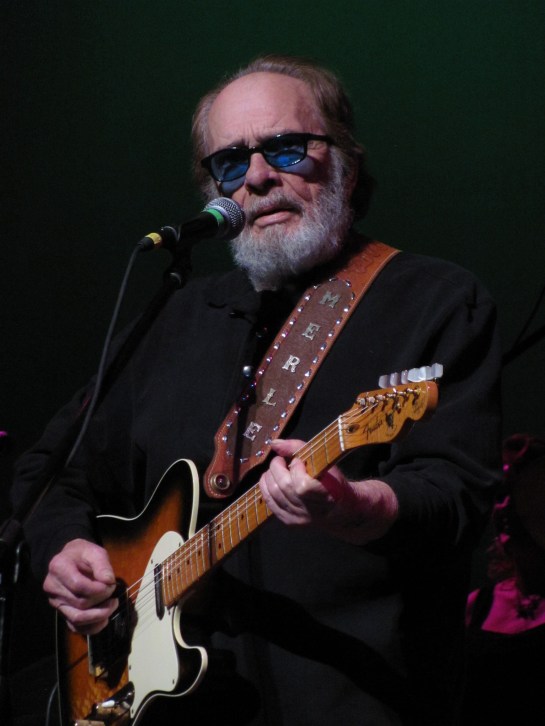
Merle Ronald Haggard (born April 6, 1937) is an American country and Western songwriter, singer, guitarist, fiddler, and instrumentalist.
Merle Haggard
Along with Buck Owens, Haggard and his band The Strangers helped create the Bakersfield sound, which is characterized by the unique twang of Fender Telecaster and the unique mix with the traditional country steel guitar sound, new vocal harmony styles in which the words are minimal, and a rough edge not heard on the more polished Nashville sound recordings of the same era.
By the 1970s, Haggard was aligned with the growing outlaw country movement, and has continued to release successful albums through the 1990s and into the 2000s. In 1994, he was inducted into the Country Music Hall of Fame. In 1997, he was inducted into the Oklahoma Music Hall of Fame.
Haggard’s parents, Flossie Mae Harp and James Francis Haggard, moved to California from their home in Checotah, Oklahoma, during the Great Depression, after their barn burned in 1934.
They settled with their children, Lowell and Lillian, in an apartment in Bakersfield, while James Francis Haggard started working for the Santa Fe Railroad. A woman who owned a boxcar, which was placed in Oildale, a nearby town north of Bakersfield, asked Haggard’s father about the possibility of converting it into a house. He remodeled the boxcar, and soon after moved in, also purchasing the lot, where Merle Ronald Haggard was born on April 6, 1937.
The property was eventually expanded by building a bathroom, a second bedroom, a kitchen and a breakfast nook in the adjacent lot.
His father died of a brain hemorrhage in 1945, an event that deeply affected Haggard during his childhood, and the rest of his life.
To support the family, his mother worked as a bookkeeper. His brother, Lowell, gave Haggard his used guitar as a gift when he was 12 years old. Haggard learned to play alone, with the records he had at home, influenced by Bob Wills, Lefty Frizzell and Hank Williams.
As his mother was absent due to work, Haggard became progressively rebellious. His mother sent him for a weekend to a juvenile detention center to change his attitude, which worsened.
Haggard committed a number of minor offences, such as thefts and writing bad checks. He was sent to a juvenile detention center for shoplifting in 1950.
When he was 14, Haggard ran away to Texas with his friend Bob Teague. He rode freight trains and hitchhiked throughout the state. When he returned the same year, he and his friend were arrested for robbery. Haggard and Teague were released when the real robbers were found. Haggard was later sent to the juvenile detention center, from which he and his friend escaped again to Modesto, California.
He worked a series of laborer jobs, including driving a potato truck, being a short order cook, a hay pitcher, and an oil well shooter. His debut performance was with Teague in a Modesto bar named “Fun Center,” being paid US$5, with free beer.
He returned to Bakersfield in 1951, and was again arrested for truancy and petty larceny and sent to a juvenile detention center. After another escape, he was sent to the Preston School of Industry, a high-security installation. He was released 15 months later, but was sent back after beating a local boy during a burglary attempt.
After his release, Haggard and Teague saw Lefty Frizzell in concert. After hearing Haggard sing along to his songs backstage, Frizzell refused to sing unless Haggard would be allowed to sing first.
He sang songs that were well received by the audience. Due to the positive reception, Haggard decided to pursue a career in music. While working as a farmhand or in oil fields, he played in nightclubs. He eventually landed a spot on the local television show Chuck Wagon, in 1956.
Married and plagued by financial issues, he was arrested in 1957 shortly after he tried to rob a Bakersfield roadhouse. He was sent to Bakersfield Jail, and was later transferred after an escape attempt to San Quentin Prison, on February 21, 1958. While in prison, Haggard discovered that his wife was expecting a child from another man, which pressed him psychologically.
He was fired from a series of prison jobs, and planned to escape along with another inmate nicknamed “Rabbit”. Haggard was convinced not to escape by fellow inmates.
Haggard started to run a gambling and brewing racket with his cellmate. After he was caught drunk, he was sent for a week to solitary confinement where he encountered Caryl Chessman, an author and death row inmate.
Meanwhile, “Rabbit” had successfully escaped, only to shoot a police officer and return to San Quentin for execution. Chessman’s predicament, along with the execution of “Rabbit,” inspired Haggard to turn his life around. Haggard soon earned a high school equivalency diploma and kept a steady job in the prison’s textile plant, while also playing for the prison’s country music band, attributing a 1958 performance by Johnny Cash at the prison as his main inspiration to join it.
Upon his release in 1960, Haggard said it took about four months to get used to being out of the penitentiary and that, at times, he actually wanted to go back in. He said it was the loneliest he had ever felt.
According to Rolling Stone, “In 1972, then–California governor Ronald Reagan expunged Haggard’s criminal record, granting him a full pardon.”
Upon his release, Haggard started digging ditches and wiring houses for his brother. Soon he was performing again, and later began recording with Tally Records.
The Bakersfield Sound was developing in the area as a reaction against the over-produced honky tonk of the Nashville Sound. Haggard’s first song was “Skid Row”.
In 1962, Haggard wound up performing at a Wynn Stewart show in Las Vegas and heard Wynn’s “Sing a Sad Song”. He asked for permission to record it, and the resulting single was a national hit in 1964.
The following year he had his first national top ten record with “(My Friends Are Gonna Be) Strangers”, written by Liz Anderson (mother of country singer Lynn Anderson) and his career was off and running.
In his 1981 autobiography Merle Haggard: Sing Me Back Home, Haggard recalls having been talked into visiting Anderson—a woman he didn’t know—at her house to hear her sing some songs she had written. “If there was anything I didn’t wanna do, it was sit around some danged woman’s house and listen to her cute little songs. But I went anyway. She was a pleasant enough lady, pretty, with a nice smile, but I was all set to be bored to death, even more so when she got out a whole bunch of songs and went over to an old pump organ…There they were.
My God, one hit right after another. There must have been four or five number one songs there…” In 1966, Haggard recorded his first number-one song “I’m a Lonesome Fugitive”, also written by Liz Anderson, which Haggard acknowledges in his autobiography remains his most popular number with audiences.”
Haggard felt a connection to the song immediately and when it was released it became his first number one country hit. When Anderson played the song for Haggard, she was unaware about his prison stretch.
“I guess I didn’t realize how much the experience at San Quentin did to him, ’cause he never talked about it all that much,” Bonnie Owens, Haggard’s backup singer and then-wife, is quoted by music journalist Daniel Cooper in the liner notes to the 1994 retrospective Down Every Road. “I could tell he was in a dark mood…and I said, ‘Is everything okay?’ And he said, ‘I’m really scared.’ And I said, ‘Why?’ And he said, ‘Cause I’m afraid someday I’m gonna be out there…and there’s gonna be some convict…some prisoner that was in there the same time I was in, stand up – and they’re gonna be about the third row down – and say, ‘What do you think you’re doing, 45200?'”
Cooper notes that the news had little effect on Haggard’s career:
“It’s unclear when or where Merle first acknowledged to the public that his prison songs were rooted in personal history, for to his credit, he doesn’t seem to have made some big splash announcement. In a May 1967 profile in Music City News, his prison record is never mentioned. But in July 1968, in the very same publication, it’s spoken of as if it were common knowledge.”
The 1966 album Branded Man kicked off an incredible artistic run for Haggard; in 2013 Haggard biographer David Cantwell states, “The immediate successors to I’m a Lonesome Fugitive – Branded Man in 1967 and, in ’68, Sing Me Back Home and The Legend of Bonnie and Clyde – were among the finest albums of their respective years.” Haggard’s new recordings largely centered around Roy Nichols’s Telecaster, Ralph Mooney’s steel guitar, and the harmony vocals provided by Bonnie Owens.
M HAGGARD
At the time of Haggard’s first top-ten hit “(My Friends Are Gonna Be) Strangers” in 1965, Owens was actually the better known performer, a fixture on the Bakersfieldclub scene who had recorded and appeared on television. Bonnie, who had been married to Buck Owens, won the new Academy of Country Music’s first ever award for Female Vocalist after her 1965 debut album, Don’t Take Advantage of Me, hit the top five on the country albums chart. However, there were no more hit singles, and although Owens recorded six solo albums on Capitol between 1965 and 1970, she became mainly known for her background harmonies on Haggard hits like “Sing Me Back Home” and “Branded Man.”
Producer Ken Nelson took a hands-off approach to producing Haggard. In the episode of American Masters dedicated to him, Haggard remembers: “The producer I had at that time, Ken Nelson, was an exception to the rule. He called me ‘Mr. Haggard’ and I was a little twenty-four, twenty-five year old punk from Oildale…
He gave me complete responsibility. I think if he’d jumped in and said, ‘Oh, you can’t do that,’ it would’ve destroyed me.” In the documentary series Lost Highway, Nelson recalls, “When I first started recording Merle, I became so enamored with his singing that I would forget what else was going on, and I suddenly realized, ‘Wait a minute, there’s musicians here you’ve got to worry about!’ But his songs – he was a great writer.”
Towards the end of the decade, Haggard went on a songwriting tear, composing several #1 hits as “Mama Tried,” “The Legend of Bonnie and Clyde,” “Hungry Eyes,” and “Sing Me Back Home.” Daniel Cooper calls “Sing Me Back Home,” “a ballad that works on so many different levels of the soul it defies one’s every attempt to analyze it.”
In a 1977 interview inBillboard with Bob Eubanks, Haggard reflected, “Even though the crime was brutal and the guy was an incorrigible criminal, it’s a feeling you never forget when you see someone you know make that last walk. They bring him through the yard, and there’s a guard in front and a guard behind – that’s how you know a death prisoner.
They brought Rabbit out…taking him to see the Father,…prior to his execution. That was a strong picture that was left in my mind.” In 1968, Haggard’s first tribute LP Same Train, Different Time: A Tribute to Jimmie Rodgers, was released to acclaim.
Okie From Muskogee”, 1969’s apparent political statement, was, according to some Merle Haggard interviews decades later, actually written as a humorous character portrait. In one such interview, Haggard called the song a “documentation of the uneducated that lived in America at the time
However, he said later on the Bob Edwards Show that “I wrote it when I recently got out of the joint. I knew what it was like to lose my freedom, and I was getting really mad at these protesters.
They didn’t know anything more about the war in Vietnam than I did. I thought how my dad, who was from Oklahoma, would have felt. I felt I knew how those boys fighting in Vietnam felt.” In the country music documentary series Lost Highway, he elaborates: “My dad passed away when I was nine, and I don’t know if you’ve ever thought about somebody you’ve lost and you say, ‘I wonder what so-and-so would think about this?’ I was drivin’ on Interstate 40 and I saw a sign that said “19 Miles to Muskogee.”
Muskogee was always referred to in my childhood as ‘back home.’ So I saw that sign and my whole childhood flashed before my eyes and I thought, ‘I wonder what dad would think about the youthful uprising that was occurring at the time, On December 19, 2006, the Kern County Board of Supervisors approved a citizen-led resolution to rename a portion of 7th Standard Road in Oildale as Merle Haggard Drive, which will stretch from North Chester Avenue west to U.S. Route 99.
The first street travelers will turn onto when they leave the new airport terminal will be Merle Haggard Drive.
In 2006, Haggard was honored as a BMI Icon at the 54th annual BMI Pop Awards. During his songwriting career, Haggard has earned 48 BMI Country Awards, nine BMI Pop Awards, a BMI R&B Award, and 16 BMI “Million-Air” awards, all from a catalog of songs that adds up to over 25 million performances.
Merle Haggard accepted the prestigious award for lifetime achievement and “outstanding contribution to American culture” from the John F. Kennedy Center for the Performing Arts on December 4, 2010. At a December 5, 2010 gala in Washington, D.C. he was honored with musical performances by Kris Kristofferson, Willie Nelson, Sheryl Crow, Vince Gill, Jamey Johnson, Kid Rock, Miranda Lambert and Brad Paisley. This tribute was featured on the December 28, 2010 CBS telecast of the Kennedy Center Honors.
On June 14, 2013, the California State University, Bakersfield, honored Merle Haggard for his contributions to the arts with the honorary degree, Doctor of Fine Arts. Haggard stepped to the podium and said, “Thank you. It’s nice to be noticed.” On January 26, 2014, Haggard performed his 1969 song “Okie from Muskogee” at the 56th Annual Grammy Awards along with Kris Kristofferson, Willie Nelson, and Blake Shelton
Gary Keck, a chemistry professor at the University of Utah and an ardent fan of Haggard, introduced a series of chemical analogues of a biologically active natural product called bryostatin 1 and named them “Merle compunds” to honor his idol’s legacy….I understood them, I got along with it, but what if he was to come alive at this moment?
And I thought, what a way to describe the kind of people in America that are still sittin’ in the center of the country sayin’, ‘What is goin’ on on these campuses?’
” In the American Masters episode about his life and career, however, a more defiant Haggard states that the song was more than a satire: “
That’s how I got into it with the hippies…I thought they were unqualified to judge America, and I thought they were lookin’ down their noses at something that I cherished very much, and it pissed me off. And I thought, ‘You sons of bitches, you’ve never been restricted away from this great, wonderful country, and yet here you are in the streets bitchin’ about things, protesting about a war that they didn’t know any more about than I did.
They weren’t over there fightin’ that war anymore than I was.” Haggard began performing the song in concert in the fall of 1969 and was astounded at the reaction it received. As David Cantwell notes in his 2013 book Merle Haggard: The Running Kind, “The Haggard camp knew they were on to something.
Everywhere they went, every show, ‘Okie’ did more than prompt enthusiastic applause. There was an unanticipated adulation racing through the crowds now, standing ovations that went on and on and sometimes left the audience and the band-members alike teary-eyed.
Merle had somehow stumbled upon a song that expressed previously inchoate fears, spoke out loud gripes and anxieties otherwise only whispered, and now people were using his song, were using him, to connect themselves to these larger concerns and to one another.”
The studio version, which is far mellower than the usually raucous concert versions, topped the charts in the fall of 1969, where it remained for a month, and also hit number 41 on the pop charts, becoming Haggard’s all-time biggest hit (until his 1973 crossover Christmas smash “If We Make It Through December”) and signature tune.
Haggard was beginning to attract attention from artists outside the country field, such as crooner Dean Martin, who recorded “I Take a Lot of Pride in What I Am” for his album of the same name in 1969.
In addition, the Gram Parsons incarnation of the Byrds had performed “Sing Me Back Home” on the Grand Ole Opry and had recorded Haggard’s “Life in Prison” for their album Sweetheart of the Rodeo the same year.
In 1969 the Grateful Dead began performing Haggard’s tune “Mama Tried”, which appeared on their 1971 eponymous live album. The song became a staple in their repertoire until the band’s end in 1995.
Singer-activist Joan Baez, whose political leanings could not be more different from those expressed in Haggard’s above-referenced songs, nonetheless covered “Sing Me Back Home” and “Mama Tried” in 1969. The Everly Brothers also used both songs in their 1968 country-rock album Roots.
In the original Rolling Stone review for Haggard’s 1968 album Mama Tried, Andy Wickham wrote, “His songs romanticize the hardships and tragedies of America’s transient proletarian and his success is resultant of his inherent ability to relate to his audience a commonplace experience with precisely the right emotional pitch…Merle Haggard looks the part and sounds the part because he is the part. He’s great.”
However, his next single, 1970’s “The Fightin’ Side of Me”, was so unapologetically right wing that it left no doubt as to where Haggard stood politically.
It became his fourth consecutive #1 country hit and also made an appearance on the pop chart, but any ideas that Haggard was a closeted liberal sympathizer were irretrievably squashed.
In the song, Haggard allows that he doesn’t mind the counterculture “switchin’ sides and standin’ up for what they believe in” but resolutely declares, “If you don’t love it, leave it!” In May 1970, Haggard explained to John Grissom of Rolling Stone, “I don’t like their views on life, their filth, their visible self-disrespect, y’ know. They don’t give a shit what they look like or what they smell like…What do they have to offer humanity?”
Ironically, Haggard had wanted to follow “Okie from Muskogee” with “Irma Jackson,” a song that dealt head-on with an interracial romance between a white man and an African-American woman.
His producer Ken Nelson discouraged him from releasing it as a single.
As Jonathan Bernstein recounts in his online Rolling Stone article “Merle Haggard Reluctantly Unveils ‘The Fightin’ Side of Me'”, “Hoping to distance himself from the harshly right-wing image he had accrued in the wake of the hippie-bashing “Muskogee,” Haggard wanted to take a different direction and release “Irma Jackson” as his next single…
When the Bakersfield, California native brought the song to his record label, executives were reportedly appalled.
In the wake of ‘Okie,’ Capitol Records was not interested in complicating Haggard’s conservative, blue-collar image.”After “The Fightin’ Side of Me” was released instead, Haggard later commented to the Wall Street Journal, “People are narrow-minded.
Down South they might have called me a nigger lover.. In an interview in 2001, Haggard stated that Nelson, who was also head of the country division at Capitol at the time, never interfered with his music but “this one time he came out and said, ‘Merle…I don’t believe the world is ready for this yet’…And he might have been right. I might’ve canceled out where I was headed in my career..
“Okie From Muskogee”, “The Fightin’ Side of Me”, and “I Wonder If They Think of Me” were hailed as anthems of the Silent Majority and presaged a trend in patriotic songs that would reappear years later with Charlie Daniels’ “In America”, Lee Greenwood’s “God Bless the USA”, and others. Haggard’s next LP was A Tribute to the Best Damn Fiddle Player in the World, dedicated to Bob Wills, which helped spark a permanent revival and expanded audience for western swing.
By this point, Haggard was one of the most famous country singers in the world, having enjoyed an immensely successful artistic and commercial run with Capitol accumulating twenty-four #1 country singles since 1966.
On Tuesday, March 14, 1972, shortly after “Carolyn” became another number one country hit, then-California governor Ronald Reagan granted Haggard a full pardon for his past crimes. In the fall of 1972, “Let Me Tell You about A Song,” the first TV special starring Merle Haggard, was nationally syndicated by Capital Cities TV Productions.
It was a semi-autobiographical, musical profile of Haggard, akin to the contemporary “Behind The Music,” produced and directed by Michael Davis. The 1973 recession anthem “If We Make It Through December” furthered Haggard’s status as a champion of the working class.
“If We Make It Through December” turned out to be Haggard’s last pop hit. Haggard appeared on the cover of TIME on May 6, 1974. He also wrote and performed the theme song to the television series Movin’ On, which in 1975 gave him another number one country hit. During the early to mid-1970s, Haggard’s chart domination continued with songs like “Someday We’ll Look Back”, “Grandma Harp”, “Always Wanting You”, and “The Roots of My Raising”.
Between 1973 and 1976, Haggard scored 9 consecutive #1 country hits. In 1977, he switched to MCA Records and began exploring the themes of depression, alcoholism, and middle age on albums like Serving 190 Proof and The Way I Am. Haggard sang a duet cover of Billy Burnette’s What’s A Little Love Between Friends with Lynda Carter in her 1980 television music special Lynda Carter: Encore!
He also scored a #1 hit in 1980 with “Bar Room Buddies,” a duet with movie star Clint Eastwood that appeared on the Bronco Billy soundtrack.
In 1981, Haggard published an autobiography, Sing Me Back Home. That same year, he alternately spoke and sang the ballad “The Man in the Mask”. Written by Dean Pitchford (whose other output includes “Fame”, “Footloose”, “Sing”, “Solid Gold”, and the musical Carrie), this was the combined narration/theme from the movie The Legend of the Lone Ranger, a box-office flop.
Haggard also jumped record labels again in 1981, moving to Epic and releasing one of his most critically acclaimed albums, Big City. Between 1981 and 1985, Haggard scored twelve Top 10 country hits, with nine of them reaching #1, including “My Favorite Memory,” “Going Where the Lonely Go,” “Someday When Things Are Good,” and “Natural High.”
In addition, Haggard recorded two chart topping duets with George Jones (“Yesterdays’ Wine” in 1982) and Willie Nelson (“Pancho and Lefty” in 1983).
Nelson believed the 1983 Academy Award-winning film Tender Mercies, about the life of fictional singer Mac Sledge, was based on the life of Merle Haggard. Actor Robert Duvall and other filmmakers denied this and claimed the character was based on nobody in particular. Duvall, however, said he was a big fan of Haggard. He won a Grammy Award for Best Male Country Vocal Performance for his 1984 remake of “That’s The Way Love Goes.” Haggard and third wife Leona Williams divorced in 1983 after five stormy years of marriage and the split, which took Haggard by surprise, served as a license to party for Haggard, who spent much of the next decade becoming mired in alcohol and drug problems. Haggard has often stated that he was in the stages of his own mid-life crisis, or “male menopause,” around this time. In the documentary Learning to Live With Myself, the singer is quoted in an interview from around the time: “Things that you’ve enjoyed for years don’t seem nearly as important, and you’re at war with yourself as to what’s happening. ‘Why don’t I like that anymore? Why do I like this now?’ And finally, I think you actually go through a biological change, you just, you become another…
Your body is getting ready to die and your mind doesn’t agree.” By the mid-eighties he was addicted to cocaine but managed to kick the habit. However, he was hampered by financial woes well into the 1990s as his presence on the charts continued to diminish as newer singers had begun to take over country music, and singers like George Strait and Randy Travis had taken over the charts. Haggard’s last number one hit was “Twinkle, Twinkle Lucky Star” from his smash album Chill Factor in 1988.
In 1989, Haggard recorded a song, “Me and Crippled Soldiers Give a Damn”, in response to the Supreme Court’s decision to allow flag burning under the First Amendment. After CBS Records Nashville avoided releasing the song, Haggard bought his way out of the contract and signed with Curb Records, which was willing to release the song.
Of the situation, Haggard commented, “I’ve never been a guy that can do what people told me…It’s always been my nature to fight the system.”
In 2000, Haggard made a comeback of sorts, signing with the independent record label Anti and releasing the spare If I Could Only Flyto critical acclaim.
He followed it in 2001 with Roots, vol. 1, a collection of Lefty Frizzell, Hank Williams, and Hank Thompson covers, along with three Haggard originals.
The album, recorded in Haggard’s living room with no overdubs, featured Haggard’s longtime bandmates The Strangers as well as Frizzell’s original lead guitarist, Norman Stephens.
In December 2004, Haggard spoke at length on Larry King Live about his incarceration as a young man and said it was “hell” and “the scariest experience of my life”.
Haggard’s number one hit single “Mama Tried” is featured in the 2003 film Radio with Cuba Gooding, Jr. and Ed Harris as well as in Bryan Bertino’s “The Strangers” with Liv Tyler. In addition, his song “Swingin’ Doors” can be heard in the 2004 film Crash and his 1981 hit “Big City” is heard in Joel and Ethan Coen’s 1996 film “Fargo” and in the 2008 Larry Bishop film “Hell Ride”.
In October 2005, Haggard released his album Chicago Wind to mostly positive reviews. The album contained an anti-Iraq war song titled “America First,” in which he laments the nation’s economy and faltering infrastructure, applauds its soldiers, and sings, “Let’s get out of Iraq, and get back on track.”
This follows from his 2003 release “Haggard Like Never Before” in which he includes a song, “That’s The News”. Haggard released a bluegrass album, The Bluegrass Sessions, on October 2, 2007.
In 2008, Haggard was going to perform at Riverfest in Little Rock, Arkansas, but the concert was canceled because he was ailing, and three other concerts were canceled as well; however, he was back on the road in June and successfully completed a tour that ended on October 19.
In April 2010, Haggard released a new album, I Am What I Am. Released to strong reviews, Haggard performed the title song on The Tonight Show with Jay Leno in February 2011. His 2014 and 2015 tour schedule has been aggressive, including over 30 cities in 2015 alone, suggesting the kind of performing stamina usually characterized by artists half Haggard’s age.
In 2000, Haggard made a comeback of sorts, signing with the independent record label Anti and releasing the spare If I Could Only Flyto critical acclaim.
He followed it in 2001 with Roots, vol. 1, a collection of Lefty Frizzell, Hank Williams, and Hank Thompson covers, along with three Haggard originals.
The album, recorded in Haggard’s living room with no overdubs, featured Haggard’s longtime bandmates The Strangers as well as Frizzell’s original lead guitarist, Norman Stephens.
In December 2004, Haggard spoke at length onLarry King Live about his incarceration as a young man and said it was “hell” and “the scariest experience of my life”.
Haggard’s number one hit single “Mama Tried” is featured in the 2003 film Radio with Cuba Gooding, Jr. and Ed Harris as well as in Bryan Bertino’s “The Strangers” with Liv Tyler.
In addition, his song “Swingin’ Doors” can be heard in the 2004 film Crash and his 1981 hit “Big City” is heard in Joel and Ethan Coen’s 1996 film “Fargo” and in the 2008 Larry Bishop film “Hell Ride”.
In October 2005, Haggard released his album Chicago Wind to mostly positive reviews. The album contained an anti-Iraq war song titled “America First,” in which he laments the nation’s economy and faltering infrastructure, applauds its soldiers, and sings, “Let’s get out of Iraq, and get back on track.” This follows from his 2003 release “Haggard Like Never Before” in which he includes a song, “That’s The News”.
Haggard released a bluegrass album, The Bluegrass Sessions, on October 2, 2007. In 2008, Haggard was going to perform at Riverfest in Little Rock, Arkansas, but the concert was canceled because he was ailing, and three other concerts were canceled as well; however, he was back on the road in June and successfully completed a tour that ended on October 19.
In April 2010, Haggard released a new album, I Am What I Am. Released to strong reviews, Haggard performed the title song on The Tonight Show with Jay Leno in February 2011.
His 2014 and 2015 tour schedule has been aggressive, including over 30 cities in 2015 alone, suggesting the kind of performing stamina usually characterized by artists half Haggard’s age.
Haggard has been married five times, first to Leona Hobbs from 1956 to 1964. They had four children: Dana, Marty, Kelli, Noel. They divorced, and in 1965 he married singer Bonnie Owens, former wife of Buck Owens, and a successful country singer at the time. Haggard has credited her with helping him make his big break as a country artist. Haggard shared the writing credit with Owens for his hit “Today I Started Loving You Again”, and has acknowledged, including on stage, that the song was about a sudden burst of special feelings he experienced for her while they were touring together.
She also helped care for Haggard’s children from his first wife and was the maid of honor for Haggard’s third marriage. Haggard and Owens divorced in 1978. In 1978 Haggard married Leona Williams; they divorced in 1983.
In 1985 Haggard married Debbie Parret, but they divorced in 1991. He married his current wife, Theresa Ann Lane, on September 11, 1993. They have two children, Jenessa and Ben.
On December 19, 2006, the Kern County Board of Supervisors approved a citizen-led resolution to rename a portion of 7th Standard Road in Oildale as Merle Haggard Drive, which will stretch from North Chester Avenue west to U.S. Route 99. The first street travelers will turn onto when they leave the new airport terminal will be Merle Haggard Drive.
In 2006, Haggard was honored as a BMI Icon at the 54th annual BMI Pop Awards. During his songwriting career, Haggard has earned 48 BMI Country Awards, nine BMI Pop Awards, a BMI R&B Award, and 16 BMI “Million-Air” awards, all from a catalog of songs that adds up to over 25 million performances.
Merle Haggard accepted the prestigious award for lifetime achievement and “outstanding contribution to American culture” from the John F. Kennedy Center for the Performing Arts on December 4, 2010. At a December 5, 2010 gala in Washington, D.C.
he was honored with musical performances by Kris Kristofferson, Willie Nelson, Sheryl Crow, Vince Gill, Jamey Johnson, Kid Rock, Miranda Lambert and Brad Paisley.
This tribute was featured on the December 28, 2010 CBS telecast of the Kennedy Center Honors. On June 14, 2013, the California State University, Bakersfield, honored Merle Haggard for his contributions to the arts with the honorary degree, Doctor of Fine Arts.
Haggard stepped to the podium and said, “Thank you. It’s nice to be noticed.” On January 26, 2014, Haggard performed his 1969 song “Okie from Muskogee” at the 56th Annual Grammy Awards along with Kris Kristofferson, Willie Nelson, and Blake Shelton
Gary Keck, a chemistry professor at the University of Utah and an ardent fan of Haggard, introduced a series of chemical analogues of a biologically active natural product called bryostatin 1 and named them “Merle compunds” to honor his idol’s legacy.
Damien Michel est originaire des bouches du Rhônes. Depuis 2012, il vit à La Garde dans le var à Côté de Toulon.
pour écouter quelques échantillons musicaux , merci de cliquer sur la photo ci dessous
To listen to some musical samples, you can click on image below
Click on image to listen / Cliquez sur l’image pour écouter
Damien Michel a découvert l’accordéon à l’âge de 7 ans, lors de vacances familiales en Auvergne. Ce fut un coup de foudre.
Aujourd’hui Damien est professeur de piano à l’école de musique de LAURIS.
Damien Michel a participé à diverses émissions de télévisions. “La chance aux chansons” “chanter la vie” “Sur un air d’accordéon” “Top accordéon”
This slideshow requires JavaScript.
Avis de notre équipe: L’album de Damien Michel “L’essayer c’est l’adopter” est une pure merveille. Pour celles, ceux qui aiment l’accordéon? C’est une oeuvre à suivre, à se procurer .