LONDON — Tucked in a trendy co-working complex in West London, just past the food court and the payment processing start-up, is perhaps the most technologically backward-looking record company in the world.
LONDON — Tucked in a trendy co-working complex in West London, just past the food court and the payment processing start-up, is perhaps the most technologically backward-looking record company in the world.
The Electric Recording Co., which has been releasing music since 2012, specializes in meticulous recreations of classical and jazz albums from the 1950s and ’60s. Its catalog includes reissues of landmark recordings by Wilhelm Furtwängler, John Coltrane and Thelonious Monk, as well as lesser-known artists favored by collectors, like the violinist Johanna Martzy.
But what really sets Electric Recording apart is its method — a philosophy of production more akin to the making of small-batch gourmet chocolate than most shrink-wrapped vinyl.
Its albums, assembled by hand and released in editions of 300 or fewer — at a cost of $400 to $600 for each LP — are made with restored vintage equipment down to glowing vacuum-tube amplifiers, and mono tape systems that have not been used in more than half a century.
The goal is to ensure a faithful restoration of what the label’s founder, Pete Hutchison, sees as a lost golden age of record-making. Even its record jackets, printed one by one on letterpress machines, show a fanatical devotion to age-old craft.
“It started as wanting to recreate the original but not make it a sort of pastiche,” Hutchison said in a recent interview. “And in order not to create a pastiche, we had to do everything as they had done it.”
Electric Recording’s attention to detail, and Hutchison’s delicate engineering style in mastering old records, have given the label a revered status among collectors — yet also drawn subtle ridicule among rivals who view its approach as needlessly expensive and too precious by half.
An original Lyrec T818 tape machine that the label has painstakingly renovated, in its London studio.Credit…Tom Jamieson for The New York Times
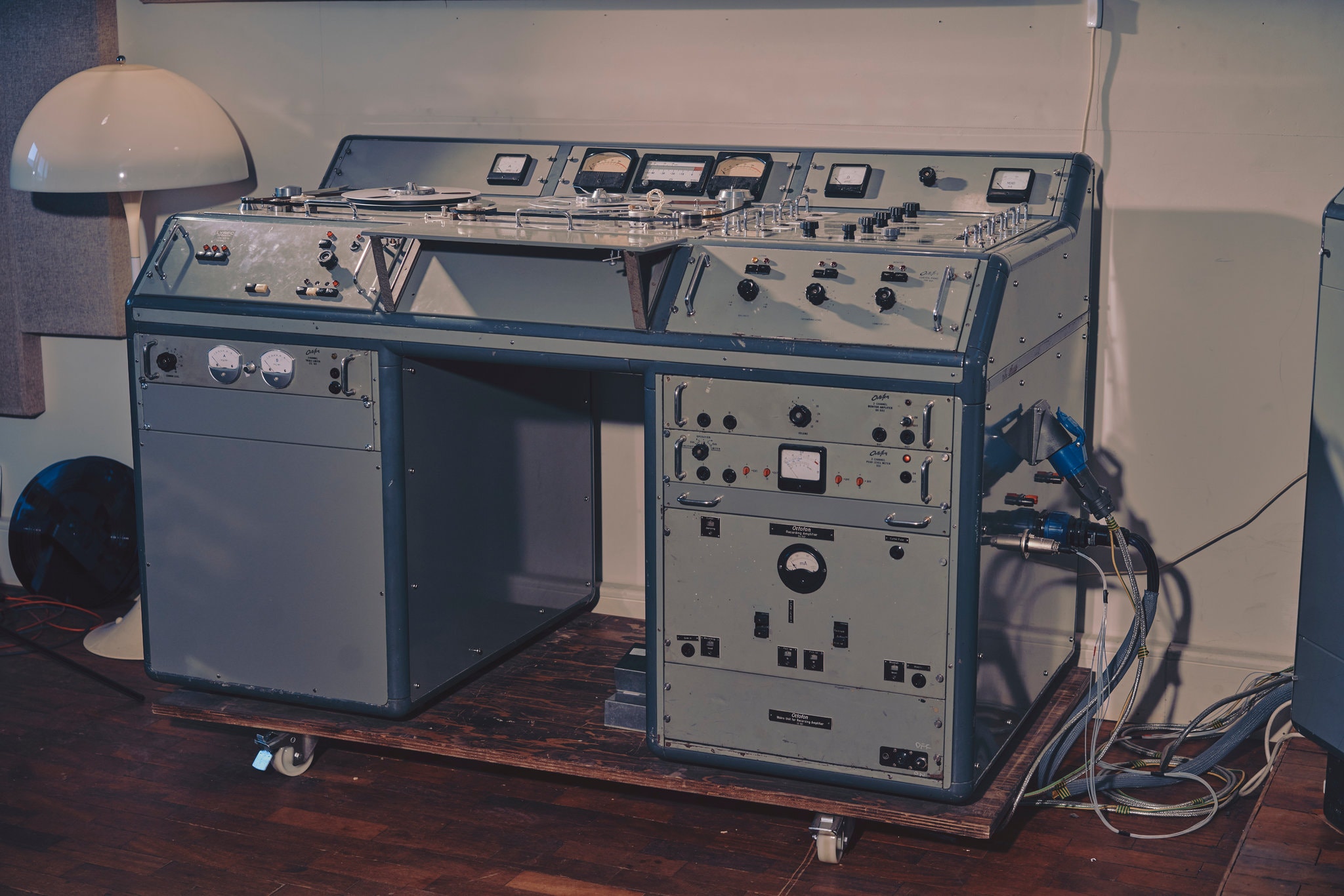
original Lyrec T818 tape machine
Hutchison, 53, whose sharp features and foot-long beard make him look like a wayward wizard from “The Lord of the Rings,” dismissed such critiques as examples of the audiophile world’s catty tribalism. Even the word “audiophile,” he feels, is more often an empty marketing gimmick than a reliable sign of quality.
“Audiophiles listen with their ears, not with their hearts,” Hutchison said. He added: “That’s not our game, really.”
So what’s his game?
“The game is trying to do something that is anti-generic, if you like,” he said. “What we’re doing with these old records is essentially taking the technology from the time and remaking it as it was done then, rather than compromising it.”
To a large degree, the vinyl resurgence of the last decade has been fueled by reissues. But no reissue label has gone to the same extremes as Electric Recording.
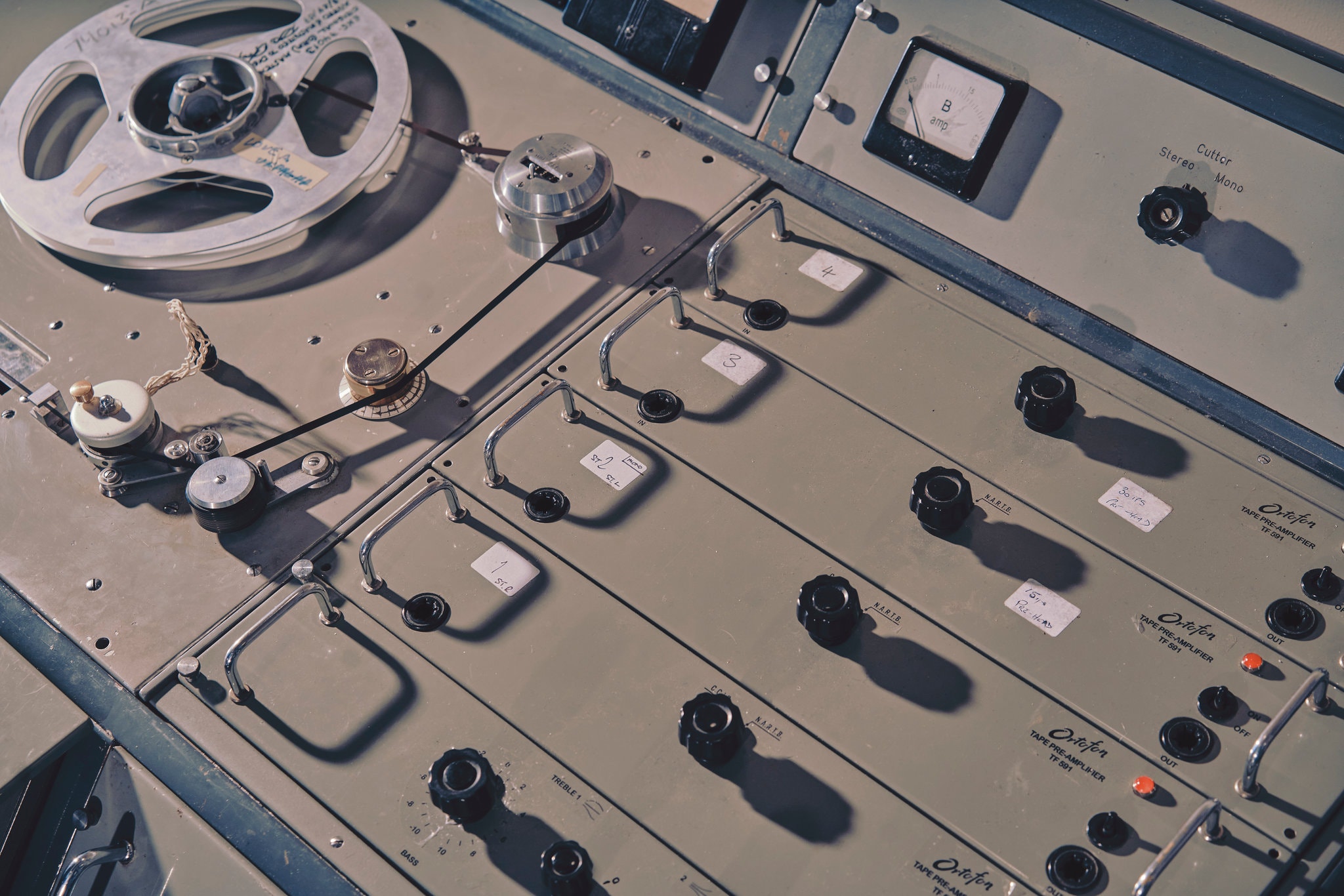
In 2009, Hutchison bought the two hulking, gunmetal-gray machines he uses to master records — a Lyrec tape deck and lathe, with Ortofon amplifiers, both from 1965 — and spent more than $150,000 restoring them over three years. He has invested thousands more on improvements like replacing their copper wiring with mined silver, which Hutchison said gives the audio signal a greater level of purity.
The machines allow Hutchison to exclude any trace of technology that has crept into the recording process since a time when the Beatles were in moptops. That means not only anything digital or computerized, but also transistors, a mainstay of audio circuitry for decades; instead, the machines’ amplifiers are powered by vacuum tubes (or valves, as British engineers call them).
“We’re all about valves here,” Hutchison said on a tour of the label’s studio.
Mastering a vinyl record involves “cutting” grooves into a lacquer disc, a dark art in which tiny adjustments can have a big effect. Unusually among engineers, Hutchison tends to master records at low volumes — sometimes even quieter than the originals — to bring out more of the natural feel of the instruments.
He demonstrated his technique during a recent mastering session for “Mal/2,” a 1957 album by the jazz pianist Mal Waldron that features an appearance by Coltrane. He tested several mastering levels for the song “One by One” — which has lots of staccato trumpet notes, played by Idrees Sulieman — before settling on one that preserved the excitement of the original tape but avoided what Hutchison called a “honk” when the horns reached a climax.
“What you want to hear is the clarity, the harmonics, the textures,” he said. “What you don’t want is to put it on and feel like you’ve got to turn it down.”
These judgments are often subjective. But to test Hutchison’s approach, I visited the New Jersey home of Michael Fremer, a contributing editor at Stereophile and a longtime champion of vinyl. We listened to a handful of Electric Recording releases, comparing them to pressings of the same material by other companies, on Fremer’s state-of-the-art test system (the speakers alone cost $100,000).
Hutchison bought the two hulking, gunmetal-gray machines he uses to master records — both from 1965 — and spent more than $150,000 restoring them over three years.Credit…Tom Jamieson for The New York Times
I am often skeptical of claims of vinyl’s superiority, but when listening to one of Electric Recording’s albums of Bach’s solo violin pieces played by Martzy, I was stunned by their clearness and beauty. Compared to the other pressings, Electric Recording’s version had vivid, visceral details, yielding a persuasive illusion of a human being standing before me drawing a bow across a violin.
“It’s magical what they’re doing, recreating these old records,” Fremer said as he swapped out more Electric Recording discs.
Hutchison is a surprising candidate to carry the torch for sepia-toned classical fidelity. In the 1990s, he was a player in the British techno scene with his label Peacefrog; the label’s success in the early 2000s with the minimalist folk of José González helped finance the obsession that became Electric Recording.
Hutchison’s conversion happened after he inherited the classical records owned by his father, who died in 1998. A longtime collector of rock and jazz, Hutchison was entranced by the sound of the decades-old originals, and found newer reissues unsatisfying. He learned that Peacefrog’s distributor, EMI, owned the rights to many of his new favorites. Was it possible to recreate things exactly has they had been done the first time around?
After restoring the machines, Electric Recording put its first three albums on sale in late 2012 — Martzy’s solo Bach sets, originally issued in the mid-1950s.
Hutchison decided that true fidelity applied to packaging as well as recording. Letterpress printing drove up his manufacturing costs, and some of the label’s projects have seemed to push the boundaries of absurdity.
In making “Mozart à Paris,” for example, a near-perfect simulacrum of a deluxe 1956 box set, Hutchison spent months scouring London’s haberdashers to find the right strand of silk for a decorative cord. The seven-disc set is Electric Recording’s most expensive title, at about $3,400 — and one of the few in its catalog that has not sold out.
Hutchison defends such efforts as part of the label’s devotion to authenticity. But it comes at a cost. Its manufacturing methods, and the quality-control attention paid to each record, bring no economies of scale. So Electric Recording would gain no reduction in expenses if it made more, thus negating the question Hutchison is most frequently asked: Why not press more records and sell them more cheaply?
“We probably make the most expensive records in the world,” Hutchison said, “and make the least profit.”
Electric Recording’s prices have drawn head-scratching through the cliquey world of high-end vinyl producers. Chad Kassem, whose company Acoustic Sounds, in Salina, Kan., is one of the world’s biggest vinyl empires, said he admired Hutchison’s work.
“I tip my hat to any company that goes the extra mile to make things as best as possible,” Kassem said.
But he said he was proud of Acoustic Sounds’s work, which like Electric Recording cuts its masters from original tapes and goes to great lengths to capture original design details — and sells most of its records for about $35. I asked Kassem what is the difference between a $35 reissue and a $500 one.
He paused for a moment, then said: “Four hundred sixty-five dollars.”
Yet the market has embraced Electric Recording. Even amid the coronavirus pandemic, Hutchison said, its records have been selling as fast as ever, although the company has had some production hiccups. The only manufacturer of a fabric that Hutchison chose for a Mozart set in the works, by the pianist Lili Kraus, has been locked down in Italy.
The next frontier for Electric Recording is rock. Hutchison recently got permission to reissue “Forever Changes,” the classic 1967 psychedelic album by the California band Love, and said that the original tape had a more unvarnished sound than most fans had heard. He expects that to be released in July, and “Mal/2” is due in August.
But Hutchison seemed most proud of the label’s work on classical records that seemed to come from a distant era. He pulled out a 10-inch mini-album of Bach by the French pianist Yvonne Lefébure, originally released in 1955. Electric Recording painstakingly recreated its dowel spine, its cotton sleeve, its leather cover embossed in gold leaf.
“It’s a nice artifact,” Hutchison said, looking at it lovingly. “It’s a great record as well.”
Source : The New York Times


 À Bruxelles, les touristes viennent en nombre pour voir le Manneken-Pis uriner de l’eau. Mais la ville était loin de se douter que ce petit jet générait un grand gaspillage.