Travel to India


Sources Youtube

Sources Youtube
Sources YouTube
Sources Wikipedia & Youtube
ALSO YOU CAN READ / WATCH
“VIENS SUR RADIOSATELLITE” Chanson enregistrée dans les Studios de RADIOSATELLITE

CLICK AND LISTEN TO MUSIC CLIQUE E OUÇA MÚSICA HAGA CLIC Y ESCUCHE MÚSICA НАЖМИТЕ И ПОСЛУШАЙТЕ МУЗЫКУ KLICKEN UND MUSIK HÖREN KLIK EN LUISTER NAAR MUZIEK CLICCA E ASCOLTA LA MUSICA クリックして音楽を聴く CLIQUEZ ET ECOUTEZ انقر واستمع إلى الموسيقى לחץ והאזין למוזיקה Fă clic și ascultă muzică Κάντε κλικ και ακούστε μουσική KLIKI JA…
VIDEOS. “JUST FOR LAUGHS” FOR YOU TO LAUGH AND ENJOY YOUR DAY / YOUR EVENING
VIDEOS “JUST FOR LAUGHS” POUR VOUS, POUR RIRE ET QUE VOUS PASSIEZ UNE BONNE JOURNÉE / BONNE SOIRÉE
ARTICLE CONSACRÉ A L’ANNIVERSAIRE DE NEIL DIAMOND LE 24 JANVIER
ARTICLE FOR NEIL DIAMOND ANNIVERSARY THE 24th of JANUARY
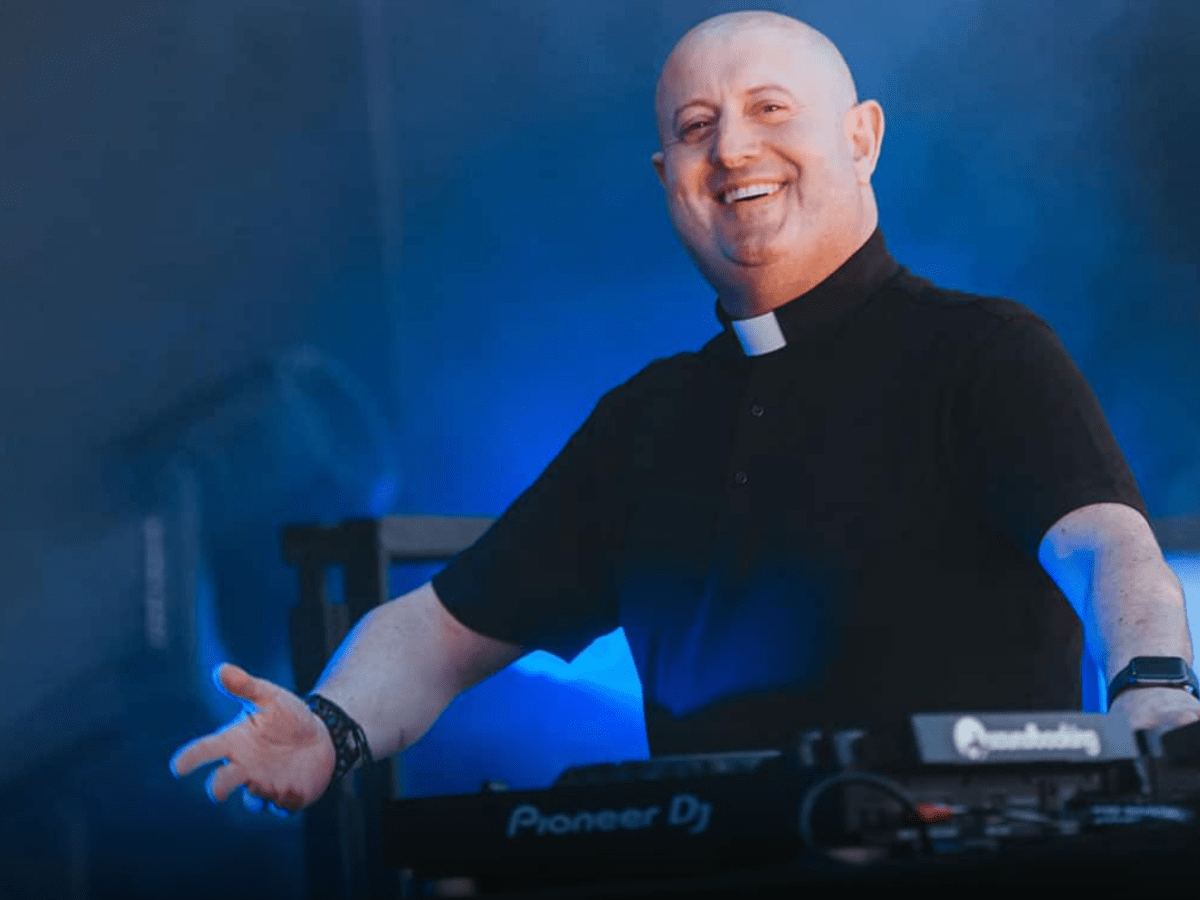
PADRE GUILHERME : UN PRÊTRE CATHOLIQUE MODERNE HORS DU COMMUN
PADRE GUILHERME: AN EXTRAORDINARY MODERN CATHOLIC PRIEST
RadioSatellite est une radio Multilingue. Vous pouvez écouter des chansons dans toutes les langues, du moment que la musique est top : Nous diffusons avec plaisir. Nos souhaits pour l’année 2026 sont à notre image. Une vidéo de souhaits pour la bonne année en plusieurs langues Ne pouvant pas tout inclure dans cette vidéo, certaines…
Click of picture to view videos on INSTAGRAM
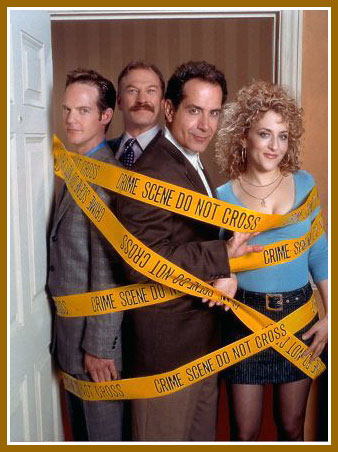
He is widely recognized for his work, having won a Golden Globe Award for Best Actor – Television Series Musical or Comedy, six Screen Actors Guild Awards and four Primetime Emmy Awards. For his work on Broadway, Shalhoub has received four Tony Award nominations, winning a Tony Award for Best Actor in a Musical for his performance as Tewfiq Zakaria in The Band’s Visit. He has also provided voice-work for the Cars franchise (2006–2017), Teenage Mutant Ninja Turtles (2014) and Teenage Mutant Ninja Turtles: Out of the Shadows (2016).
Shalhoub, the ninth of ten children, was born and raised in a Lebanese Maronite Christian household in Green Bay, Wisconsin. His father, Joe, was from Mount Lebanon, and immigrated to the United States, after his own parents, Melhem and Mariam, were both killed during World War I.

He was a meat peddler who drove a refrigerated truck. Joe married Shalhoub’s mother, Helen (née Srouji ), a Lebanese-American. The two met when Joe was taken in to be raised by her family, when both were little. One of Shalhoub’s maternal great-great-grandfathers, Abdel Naim, though a Christian Maronite Lebanese, was killed in the Hamidian massacres committed against Armenians in the Ottoman Empire in 1895. Shalhoub was introduced to acting by an older sister who put his name forward to be an extra in a high school production of The King and I.
After graduating from Green Bay East High School, he spent a short time at the University of Wisconsin-Green Bay before participating in the National Student Exchange to the University of Southern Maine where he later transferred and earned a bachelor’s degree. He later went on to earn a master’s degree from the Yale School of Drama in 1980. Shalhoub is also fluent in Lebanese.
Shalhoub married actress Brooke Adams in 1992. They have worked together in several films, one episode of Wings, and on BrainDead. Adams has appeared credited as a “Special Guest Star” in five episodes of Monk—”Mr. Monk and the Airplane“, “Mr. Monk’s 100th Case”, “Mr. Monk and the Kid”, “Mr. Monk Visits a Farm”, and “Mr. Monk and the Badge”.
Shalhoub and Adams appeared on Broadway together in the 2010 revival of Lend Me a Tenor. At the time of their wedding, Adams had an adopted daughter, Josie Lynn (born 1989), whom Shalhoub adopted. In 1994, they adopted another daughter, Sophie (born 1993).
Tony’s brother Michael is also an actor who made multiple guest appearances on Monk. He first appears in “Mr. Monk and the Missing Granny”, as a member of a disbanded radical group suspected of involvement in a kidnapping. In “Mr. Monk Bumps His Head”, he plays a Wyoming beekeeper who is annoyed when a suspect crashes a car into his farm. Michael also appears in “Mr. Monk Is the Best Man” as the minister presiding at Leland Stottlemeyer‘s wedding.
In May 2020, Shalhoub revealed that he and his wife Brooke had tested positive for COVID-19 the previous month, remarking that “we really are all Monk now”, and that they had recovered after “a pretty rough few weeks”.
Surtout que l’un des acteurs de ce film : LIAM NEESON qui , pour la première fois, sans doute, a joué dans cette catégorie de films de cinéma. En général, Liam Neeson, opte pour des films d’action, de violence, plutôt sérieux ( enfin, dans le sens où ca ne rigole pas).
L’actrice principale : CHARLIZE THERON
L’acteur principal : SETH MAC FARLANE ( producteur et réalisateur du film )
Nous pouvons voir passer DOC BROWN ( Christopher LLOYD ) de passage dans le far west venant du futur ( BACK TO THE FUTURE).
Passage aussi de BILL MAHER qui reproduira , dans le far west, une réplique de ses émissions TV
Pour résumer: Ce film vaut le détour.
Pour vous donner un avant goût, quelques vidéos choisies pour vous dans cet article.
Visionnez les. Ca vaudra le détour
Et si vous avez l’occasion de voir le film ( en DVD ou en VOD ) n’hésitez pas.
Il passe aussi sur les chaines OCS de temps en temps. ( Si vous auriez un abonnement des chaines de ce groupe cinéma)
En 1882, Albert Stark (Seth MacFarlane) vit dans la ville de Vieille Souche (Old Stump en version originale et québécoise). C’est un éleveur de moutons, plutôt lâche, qui vient de perdre sa petite amie Louise (Amanda Seyfried). Il s’entraîne alors pour devenir un as de la gâchette, avec l’aide d’Anna (Charlize Theron), la femme du célèbre hors-la-loi Clinch (Liam Neeson). Mais les choses se compliquent lorsqu’Albert et Anna tombent amoureux l’un de l’autre..
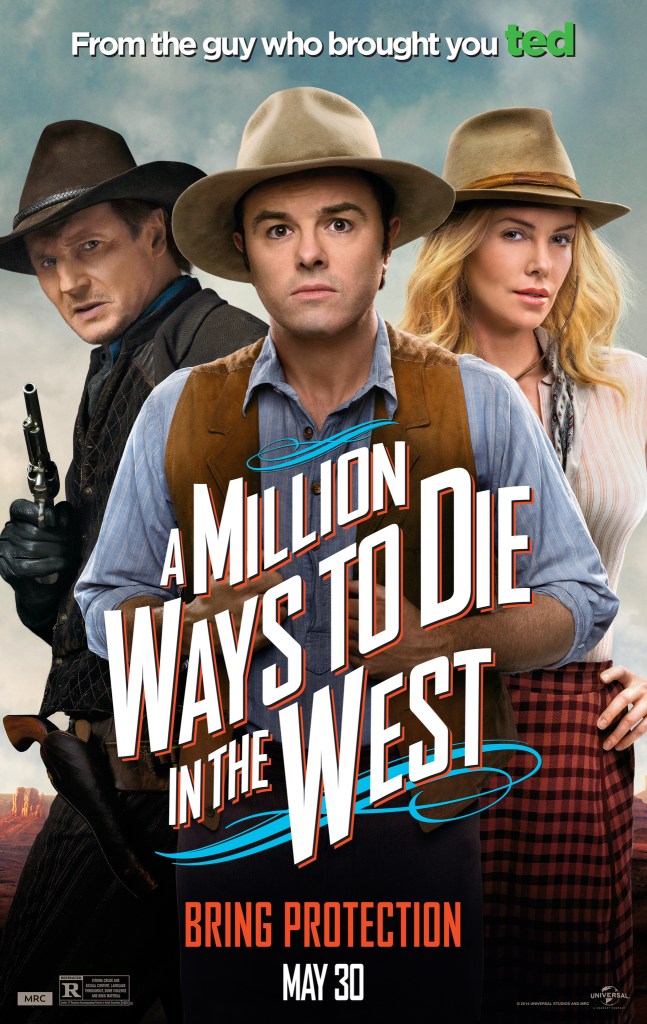
A Million Ways to Die in the West is a 2014 American Western comedy film directed by Seth MacFarlane, who wrote the screenplay with Alec Sulkin and Wellesley Wild. The film features an ensemble cast including MacFarlane, Charlize Theron, Amanda Seyfried, Neil Patrick Harris, Giovanni Ribisi, Sarah Silverman, and Liam Neeson. The film follows a cowardly frontiersman who gains courage with the help of a female gunfighter and must use his newfound skills in a confrontation with her villainous outlaw husband.
Development for A Million Ways to Die in the West began while MacFarlane and co-writers Sulkin and Wild were watching western movies during the development of Ted. Casting was done between December 2012 and March 2013. Filming began on May 6, 2013, in various locations in New Mexico including Albuquerque and Santa Fe, and it concluded on August 9 that year. Joel McNeely composed the score.
The film was released on May 30, 2014, in the United States, and distributed worldwide by Universal Pictures. The film received mixed reviews from critics, with criticism for its length. It was released on DVD and Blu-ray on October 7, 2014, and earned more than $15 million in home media sales
In 1882, in the town of Old Stump, Arizona, timid sheep farmer Albert Stark (Seth MacFarlane) has broken up with his girlfriend Louise (Amanda Seyfried) as a result of his refusal to participate in a gunfight. He prepares to migrate to San Francisco, believing that the frontier offers nothing for him. Meanwhile, infamous outlaw Clinch Leatherwood (Liam Neeson) robs and kills an old prospector (Matt Clark) for a gold nugget. He orders his right-hand man Lewis (Evan Jones) to escort his wife Anna (Charlize Theron) to Old Stump to lie low while he continues his banditry.
Lewis and Anna arrive in Old Stump under the disguise of two siblings intending to build a farm, but Lewis is arrested after shooting the Pastor’s (John Aylward) son in a saloon. During the brawl, Albert saves Anna from being crushed by two of the patrons, and the two become close friends. They attend a county fair where Louise’s new boyfriend, the arrogant Foy (Neil Patrick Harris), challenges Albert to a shooting contest. Albert is defeated, but Anna steps in and defeats Foy. Foy publicly humiliates Albert, who impulsively challenges Foy to a duel in a week’s time to win back Louise. Anna then spends the week teaching Albert how to shoot.
During a barn dance the night before the duel, Anna gives Foy a Mickey. After leaving the dance, Albert and Anna kiss before heading home. Upon breaking out of jail and murdering the sheriff, Lewis observes the kiss and reports it to Clinch. On the day of the duel, Foy arrives late and gets diarrhea from the laxative he had unknowingly drunk. Albert, who has decided that Louise is not worth fighting for, once again forfeits the duel. He retires to the saloon, but Clinch arrives and demands to know who kissed his wife. He reveals that Anna is his wife and threatens to continue killing more people unless his wife’s lover duels him at noon the next day. Later, Clinch confronts Anna by demanding that she reveal Albert’s name and his whereabouts or he will kill her. Before he attempts to have sex with her, she knocks him unconscious with a rock and escapes.
Anna returns to Albert’s farm to warn him about Clinch, but he chastises her for lying to him. Clinch, having regained consciousness, tracks down Anna to the farm, but Albert helps her escape, then escapes himself. While fleeing, he is captured by a tribe of Apache Indians, who threaten to burn him alive. The Apaches spare him when he reveals that he can speak their language. They give him a bowl of peyote, which sends him flashing back to his birth and through painful events of his childhood before making him realize that he loves Anna.
Meanwhile, Clinch recaptures Anna in town, but Albert returns to Old Stump and confronts him. He wounds Clinch with a bullet poisoned with rattlesnake venom before his own gun is shot out of his hand, but he manages to stall until Clinch fatally succumbs to the poison. Louise attempts to win back Albert, but he rejects her and instead happily enters a relationship with Anna, who becomes his new wife. Albert also receives a bounty for killing Clinch and uses the money to buy more sheep.
In a pre-credits scene, the proprietor of a racist shooting game called “Runaway Slave” at the fair asks who would like to take a shot. Django Freeman (Jamie Foxx) steps up and shoots the man while commenting that “people die at the fair”.
The score was composed by Joel McNeely. The soundtrack was released by Back Lot Music on May 27, 2014. The theme song “A Million Ways to Die” is performed by Alan Jackson. It was released as a single on April 29, 2014. A portion of the Back to the Future theme by Alan Silvestri is used during Christopher Lloyd’s cameo. Near the end of the movie, the refrain of “Tarzan Boy” by Baltimora is used as a fictional “Muslim Death Chant.” Track listing
All music is composed by Joel McNeely, except as noted.
| No. | Title | Length |
|---|---|---|
| 1. | “A Million Ways to Die” (performed by Alan Jackson) | 2:27 |
| 2. | “Main Title” | 2:33 |
| 3. | “Missing Louise” | 2:08 |
| 4. | “Old Stump” | 0:45 |
| 5. | “Saloon Brawl” | 1:50 |
| 6. | “Rattlesnake Ridge” | 1:28 |
| 7. | “People Die at the Fair” | 2:11 |
| 8. | “The Shooting Lesson” | 2:16 |
| 9. | “The Barn Dance” | 2:29 |
| 10. | “If You’ve Only Got a Moustache” (composed by Stephen Foster, performed by Amick Byram) | 1:31 |
| 11. | “Anna and Albert” | 4:19 |
| 12. | “Clinch Hunts Albert” | 3:41 |
| 13. | “Racing the Train” | 2:21 |
| 14. | “Captured by Cochise” | 2:07 |
| 15. | “Albert Takes a Trip” | 2:24 |
| 16. | “The Showdown” | 2:20 |
| 17. | “Sheep to the Horizon” | 2:00 |
| 18. | “End Title Suite” |
A Million Ways to Die in the West grossed $43.1 million in North America and $43.3 million in other territories, for a worldwide total of $86.4 million, against its $40 million budget.
The film grossed $16.8 million in its opening weekend, finishing in third place at the box office behind fellow newcomer Maleficent and the previous weekend’s opener X-Men: Days of Future Past. This was below expectations of $26 million. In its second weekend, the film dropped to number five, grossing an additional $7.3 million. In its third weekend, the film dropped to number eight, grossing $3.2 million. In its fourth weekend, the film dropped to number 11, grossing $1.6 million.




They are a family of four based in Thornhill, Ontario, Canada consisting of the father (Andrés Burgos, known as Papa Bee), the mother (Rossana Burgos, known as Mama Bee), the son (Roberto Burgos, known as Mr Monkey or Mr Bee), and the daughter (Gabriela Burgos, also known as Gabriela Bee, Miss Monkey, or Miss Bee).

Miss BEE ( Gabriela BEE )
Great video: Miss BEE x 5 on the same video: Amaizing
We love this video : Wonderful family
The Eh Bee Family first started posting vines in January 2013. They became popular on Vine and made it their career. Their social media accounts include Vine, YouTube, Instagram, and Facebook. They have also starred in sponsored advertisements for such companies as Johnson & Johnson, Toyota, and Regal Cinemas and have also been featured in the New York Daily News, on Buzzfeed, Good Morning America, Today.com, and other media outlets. The family’s social media was nominated for a Streamy Award in 2015 and a Shorty Award in 2016. On February 17, 2018, Gabriela Bee released her song “Sound in Color”. On September 1, 2018, Gabriela Bee released another song, “Something More”.
Sources Youtube / Wikipedia
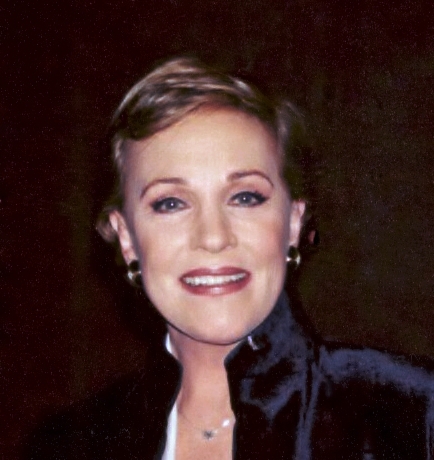
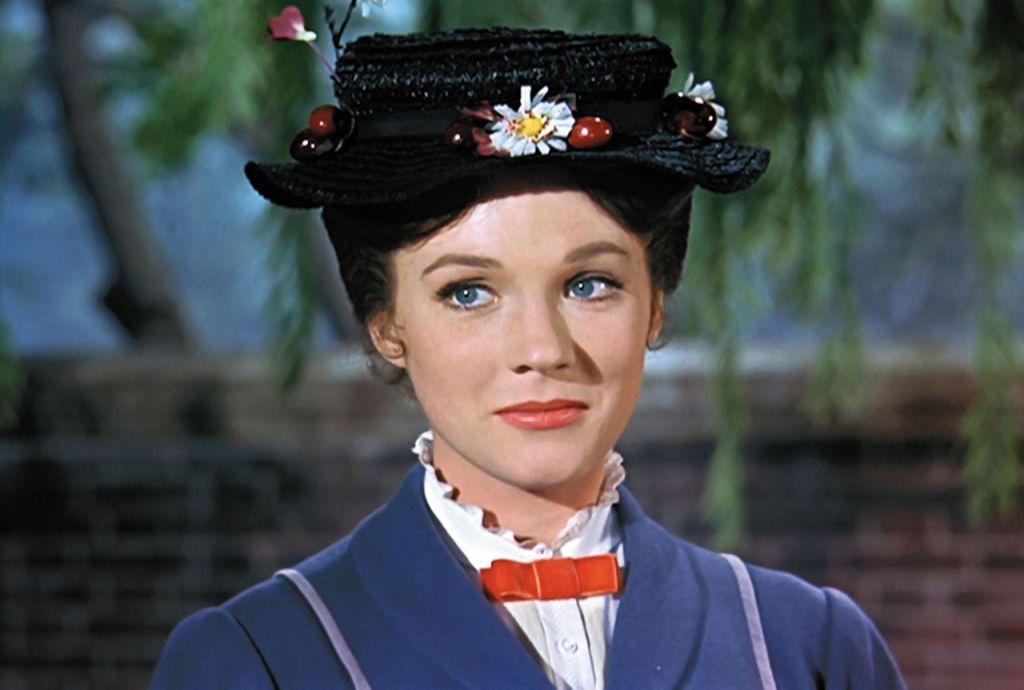
Andrews, a child actress and singer, appeared in the West End in 1948 and made her Broadway debut in The Boy Friend (1954). Billed as “Britain’s youngest prima donna“, she rose to prominence starring in Broadway musicals such as My Fair Lady (1956) playing Eliza Doolittle and Camelot (1960) playing Queen Guinevere. On 31 March 1957, Andrews starred in the premiere of Rodgers and Hammerstein‘s written-for-television musical Cinderella, a live, colour CBS network broadcast seen by over 100 million viewers. Andrews made her feature film debut in Walt Disney‘s Mary Poppins (1964) and won the Academy Award for Best Actress for her performance in the title role. The following year she starred in the musical film The Sound of Music (1965), playing Maria von Trapp and won the Golden Globe Award for Best Actress – Motion Picture Comedy or Musical.
Between 1964 and 1986, Andrews starred in various films working with directors including her husband Blake Edwards, George Roy Hill, and Alfred Hitchcock in The Americanization of Emily (1964), Hawaii (1966), Torn Curtain (1966), Thoroughly Modern Millie (1967), Star! (1968), The Tamarind Seed (1974), 10 (1979), S.O.B. (1981), Victor/Victoria (1982), That’s Life! (1986), and Duet for One (1986). After 1986 her workload decreased, appearing in two films in 1991 and not again until 2000. After the turn of the new millennium, however, her career had a revival. From 2001 to 2004 Andrews starred in The Princess Diaries (2001) and The Princess Diaries 2: Royal Engagement (2004). From 2004 to 2018 she lent her voice to the Shrek and Despicable Me animated films and Aquaman (2018). In 2017 she co-created and hosted a children’s educational show titled Julie’s Greenroom, for which she received two Daytime Emmy Award nominations. Beginning in 2020, Andrews voiced the narrator Lady Whistledown in the Netflix series Bridgerton. She has also worked hosting performance shows such as Great Performances and narrating documentaries such as the 2004 Emmy-winning series Broadway: The American Musical.
In 2002, Andrews was ranked No. 59 in the BBC’s poll of the 100 Greatest Britons. In 2003, she revisited her first Broadway success, this time as a stage director, with a revival of The Boy Friend. Apart from her musical career, she is also an author of children’s books and has published two autobiographies, Home: A Memoir of My Early Years (2008) and Home Work: A Memoir of My Hollywood Years (2019).
Julia Elizabeth Wells was born on 1 October 1935 in Walton-on-Thames, Surrey, England. Her mother, Barbara Ward Wells (née Morris; 1910–1984) was born in Chertsey and married Edward Charles “Ted” Wells (1908–1990), a teacher of metalwork and woodwork, in 1932.
Andrews was conceived as a result of an affair her mother had with a family friend. Andrews discovered her true parentage from her mother in 1950, although it was not publicly disclosed until her 2008 autobiography.
With the outbreak of World War II, her parents went their separate ways and were soon divorced. Each remarried: Barbara to Ted Andrews, in 1943, and Ted Wells in 1944 to Winifred Maud (Hyde) Birkhead, a war widow and former hairstylist at a war work factory that employed them both in Hinchley Wood, Surrey. Wells assisted with evacuating children to Surrey during the Blitz, while Andrews’s mother joined her husband in entertaining the troops through the Entertainments National Service Association. Andrews lived briefly with Wells and her brother, John in Surrey. In 1940, Wells sent her to live with her mother and stepfather, who Wells thought would be better able to provide for his talented daughter’s artistic training. According to Andrews’s 2008 autobiography Home, while Andrews had been used to calling her stepfather “Uncle Ted”, her mother suggested it would be more appropriate to refer to her stepfather as “Pop”, while her father remained “Dad” or “Daddy” to her, a change which she disliked. The Andrews family was “very poor” and “lived in a bad slum area of London,” at the time, stating that the war “was a very black period in my life.” According to Andrews, her stepfather was violent and an alcoholic. He twice, while drunk, tried to get into bed with his stepdaughter, resulting in Andrews fitting a lock on her door.
As the stage career of her mother and stepfather improved, they were able to afford better surroundings, first to Beckenham and then, as the war ended, back to the Andrews’s hometown of Hersham. The family took up residence at the Old Meuse, in West Grove, Hersham, a house (now demolished) where Andrews’s maternal grandmother had served as a maid. Andrews’s stepfather sponsored lessons for her, first at the independent arts educational school Cone-Ripman School (ArtsEd) in London, and thereafter with concert soprano and voice instructor Madame Lilian Stiles-Allen. Andrews said of Stiles-Allen, “She had an enormous influence on me,” adding, “She was my third mother – I’ve got more mothers and fathers than anyone in the world.” In her memoir Julie Andrews – My Star Pupil, Stiles-Allen records, “The range, accuracy and tone of Julie’s voice amazed me … she had possessed the rare gift of absolute pitch”, though Andrews herself refutes this in her 2008 autobiography Home. According to Andrews, “Madame was sure that I could do Mozart and Rossini, but, to be honest, I never was”. Of her own voice, she says, “I had a very pure, white, thin voice, a four-octave range – dogs would come from miles around.” After Cone-Ripman School, Andrews continued her academic education at the nearby Woodbrook School, a local state school in Beckenham.
Termed “Britain’s youngest prima donna”, Andrews’s classically trained soprano voice, lauded for its “pure and clear” sound, has been described as light, bright and operatic in tone. When a young Andrews was taken by her parents to be examined by a throat specialist, the doctor concluded that she had “an almost adult larynx.” Despite the continual encouragement to pursue opera by her voice teacher, English soprano Lilian Stiles-Allen, Andrews herself felt that her voice was unsuited for the genre and “too big a stretch”. At the time, Andrews described her own voice as “extremely high and thin”, feeling that it lacked “the necessary guts and weight for opera”, preferring musical theatre instead.
As Andrews aged, so did her voice, which began to naturally deepen. Losing her vast upper register, her “top notes” became increasingly difficult to sing while “her middle register matured into the warm golden tone” for which she has become known, according to Tim Wong of The Daily Telegraph.
Musically, she had always preferred singing music that was “bright and sunny”, choosing to avoid songs that were sad or otherwise written in a minor key, for fear of losing her voice “in a mess of emotion”. She cited this as another reason for avoiding opera.

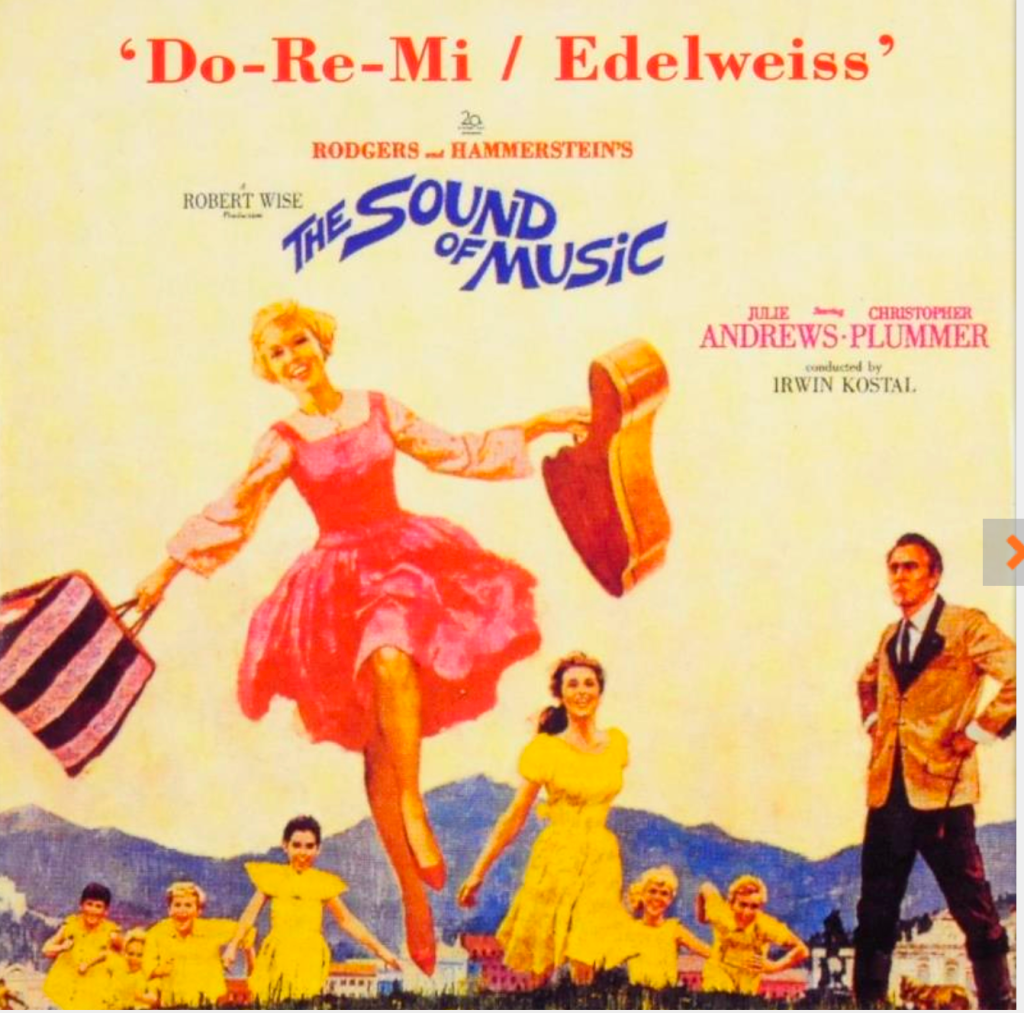
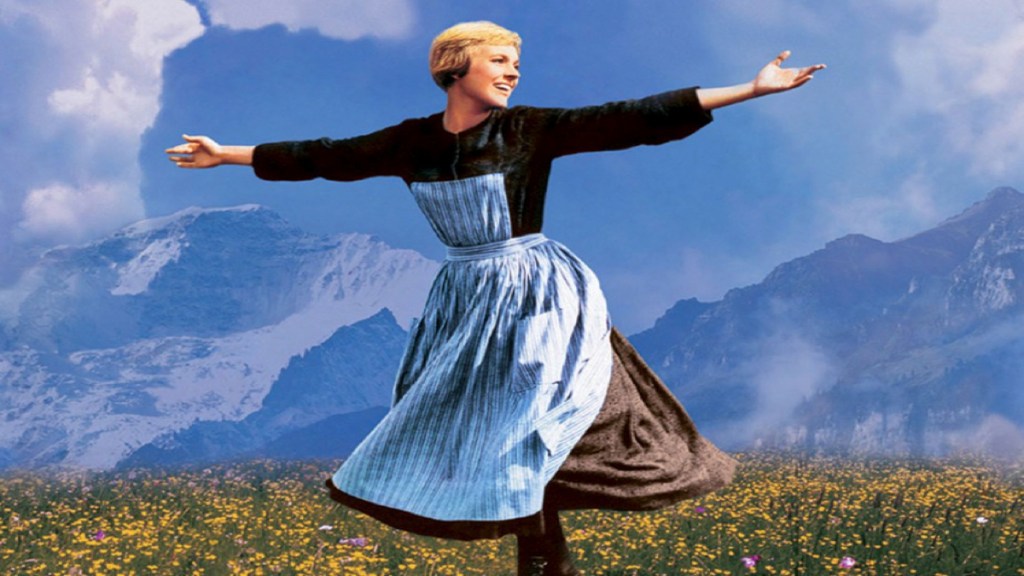


Additional informations about “the sound of music” : The original Broadway cast. The original Broadway cast was started by Mary Martin. Her singing style was very different than Julie Andrews’s style.
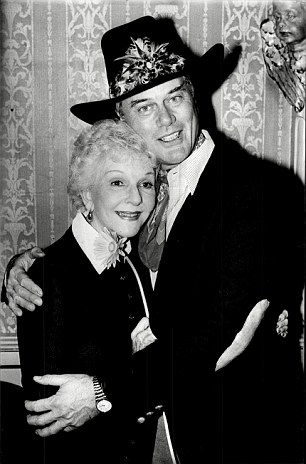
(Mary Martin was Larry hagman’s mother)


Sources Youtube / Wikipedia
Des endroits autres que ceux déjà connus et que la plupart des gens visitent.
Faisons un tour
Places other than those already known and that most people visit.
let’s take a walk
Seidler read about George VI’s life after learning to manage a stuttering condition he developed during his own youth. He started writing about the relationship between the therapist and his royal patient as early as the 1980s, but at the request of the King’s widow, Queen Elizabeth The Queen Mother, postponed work until her death in 2002. He later rewrote his screenplay for the stage to focus on the essential relationship between the two protagonists. Nine weeks before filming began, Logue’s notebooks were discovered and quotations from them were incorporated into the script.
Principal photography took place in London and around Britain from November 2009 to January 2010. Hard light was used to give the story a greater resonance and wider-than-normal lenses were employed to recreate the Duke of York’s feelings of constriction. A third technique Hooper employed was the off-centre framing of characters.
The King’s Speech was a major box office and critical success. It was widely praised by film critics for its visual style, art direction, screenplay, directing, score, and acting. Other commentators discussed the film’s representation of historical detail, especially the reversal of Winston Churchill‘s opposition to abdication. The film received many awards and nominations, particularly for Colin Firth’s performance, which resulted in his first Oscar win for Best Actor. At the 83rd Academy Awards, The King’s Speech received 12 Oscar nominations, more than any other film in that year, and subsequently won four, including Best Picture. Censors initially gave it adult ratings due to profanity, though these were later revised downwards after criticism by the makers and distributors in the UK and some instances of swearing were muted in the US. On a budget of £8 million, it earned over £250 million internationally.
At the official closing of the British Empire Exhibition at Wembley Stadium, Prince Albert, Duke of York, the second son of King George V, addresses the crowd with a strong stammer. His search for treatment has been discouraging, but his wife, Elizabeth, persuades him to see the Australian-born Lionel Logue, a non-medically trained Harley Street speech defects therapist. “Bertie”, as he is called by his family, believes the first session is not going well, but Lionel, who insists that all his patients address him as such, has his potential client recite Hamlet‘s “To be, or not to be” soliloquy while hearing classical music played on a pair of headphones. Bertie is frustrated at the experiment but Lionel gives him the acetate recording that he has made of the reading as a souvenir.
After Bertie’s father, King George V, broadcasts his 1934 Royal Christmas Message, he explains to Bertie that the wireless will play a significant part in the role of the royal family, allowing them to enter the homes of the people, and that Bertie’s brother’s neglect of his responsibilities make training in it necessary. The attempt at reading the message himself is a failure, but that night Bertie plays the recording Lionel gave him and is astonished at the lack of stutter there. He therefore returns for daily treatments to overcome the physical and psychological roots of his speaking difficulty.
George V dies in 1936, and his eldest son David ascends the throne as King Edward VIII. A constitutional crisis arises with the new king over a prospective marriage with the twice-divorced American socialite Wallis Simpson. Edward, as the supreme governor of the Church of England, cannot marry her, even if she receives her second divorce, since both her previous husbands are alive.
At an unscheduled session, Bertie expresses his frustration that, while his speech has improved when speaking to most people, he still stammers when talking to David, at the same time revealing the extent of Edward VIII’s folly with Simpson. When Lionel insists that Bertie himself could make a good king, Bertie accuses Lionel of speaking treason and quits Lionel in anger. Bertie must now face the Accession Council without any assistance.
Bertie and Lionel only come together again after King Edward decides to abdicate in order to marry. Bertie, urged ahead by Prime Minister Stanley Baldwin, ascends the throne as King George VI and visits Lionel’s home with his wife before their coronation, much to the surprise of Mrs. Logue when she comes upon Queen Elizabeth having tea at her dining room table. This is the first time that she learns who her husband’s patient has been.
Bertie and Lionel’s relationship is questioned by the King’s advisors during the preparations for his coronation in Westminster Abbey. The archbishop of Canterbury, Cosmo Gordon Lang, brings to light that George never asked for advice from his advisors about his treatment and that Lionel has never had formal training. Lionel explains to an outraged Bertie that at the time he started with speech defects there were no formal qualifications and that the only known help that was available for returning Great War shell-shocked Australian soldiers was from personal experience. Bertie remains unconvinced until provoked to protest at Lionel’s disrespect for King Edward’s Chair and the Stone of Scone. Only at this pivotal moment, after realising he has just expressed himself without impairment, is Bertie able to rehearse with Lionel and complete the ceremony.
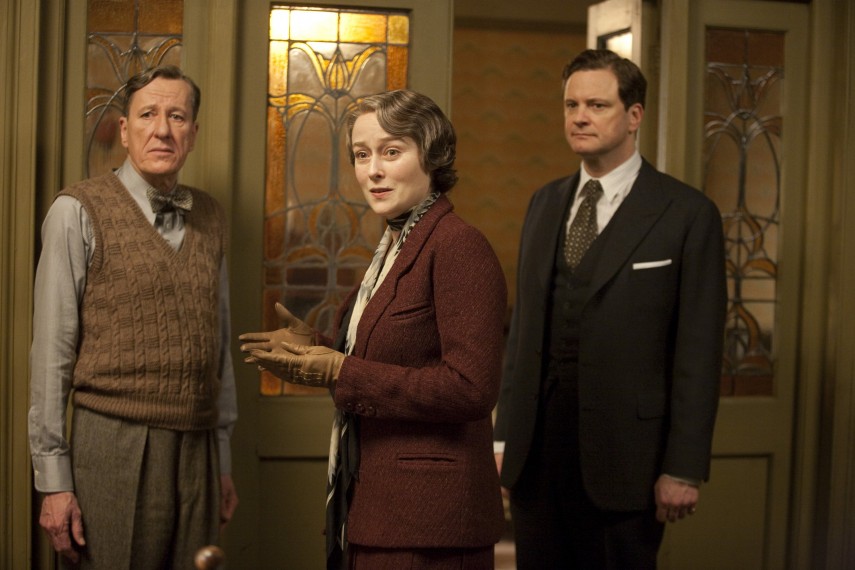
As the new king, Bertie is in a crisis when he must broadcast to Britain and the Empire following the declaration of war on Nazi Germany in 1939. Lionel is summoned to Buckingham Palace to prepare the king for his speech. Knowing the challenge that lies before him, Lang, Winston Churchill, and Prime Minister Neville Chamberlain are present to offer support. The King and Logue are then left in the broadcasting room. He delivers his speech with Logue conducting him, but by the end he is speaking freely. Preparing to leave the room for the congratulations of those present, Logue mentions to the King that he still has difficulty enunciating w and the King jokes back, “I had to throw in a few so they’d know it was me.”
As the Royal Family step onto the palace balcony and are applauded by the crowd, a title card explains that Logue, who received the Royal Victorian Order for service to the Crown, was always present at King George VI’s speeches during the war and that they remained friends until the King’s death from lung cancer in 1952.


Comme vous le constatez, chers lectrices, lecteurs, en ce début d’année, nous favorisons “le rire”
et la bonne humeur.
Dans le petit hameau de Highwater, dans le Vermont, un petit garçon découvre un cadavre fraîchement mort apparu à flanc de colline au-dessus de la ville, il part vite chercher sa mère. Au même moment, un vieux chasseur tombe sur le même cadavre et pense l’avoir tué. Les habitants du lieu sont les uns après les autres confrontés au cadavre Le problème de savoir qui est la personne, qui était responsable de sa mort subite et ce qui devrait être fait avec le corps est «le problème avec Harry».
Le capitaine Wiles est persuadé qu’il a tué l’homme avec un tir égaré de son fusil en chassant, jusqu’à ce qu’il soit démontré qu’il a effectivement tiré sur un lapin. Jennifer Rogers, l’épouse de Harry, croit qu’elle a tué Harry parce qu’elle l’a frappé violemment avec une bouteille de lait. Mlle Gravely est certaine que l’homme est décédé après un coup du talon de sa botte de randonnée lorsqu’il s’est jeté sur elle hors des buissons, encore étourdi par le coups qu’il a reçu de Jennifer. Sam Marlowe, un artiste peintre original, mais ouvert d’esprit sur l’ensemble de l’événement et est prêt à aider ses voisins et ses nouveaux amis de toutes les manières possibles. En tout cas, personne n’est bouleversé du tout par la mort de Harry.
Cependant, ils espèrent tous que le corps ne sera pas porté à l’attention des autorités, incarnées par le zèle du shérif adjoint, Calvin Wiggs, froid et sans humour, et qui gagne des primes à chaque verbalisation ou arrestation. Le capitaine, Jennifer, Mlle Gravely et Sam enterrent le corps puis le déterrent à nouveau plusieurs fois au cours de la journée. Ils cachent ensuite le corps dans une baignoire. Le médecin local alerté diagnostique une mort naturelle, aucun acte criminel n’a donc été commis. Les protagonistes décident alors de replacer le cadavre sur la colline où il a été découvert la première fois, afin de le faire apparaître comme s’il venait d’être découvert.
Entre-temps, Sam et Jennifer sont tombés amoureux et souhaitent se marier, et le capitaine et Miss Gravely sont également devenus un couple. Sam a pu vendre toutes ses peintures à un millionnaire de passage, bien que Sam refuse d’accepter de l’argent et demande à la place quelques cadeaux simples pour ses amis et lui-même dont un lit à deux places pour lui et Jennifer