Sophia Loren


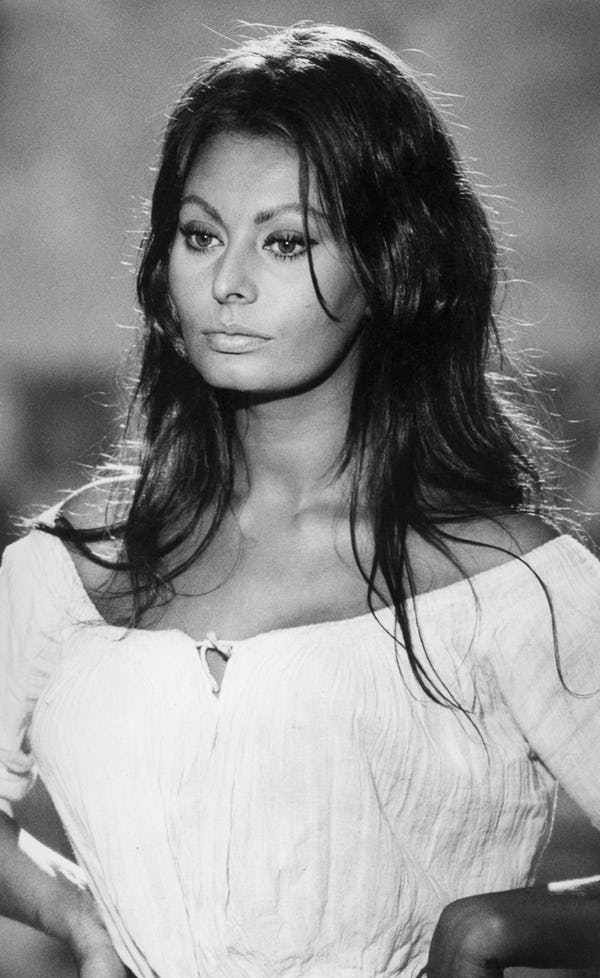
Sofia Villani Scicolone ,  Sophia Loren , est une actrice italienne née le 20 septembre 1934 à Rome.

Actrice parmi les plus importantes du cinéma italien, mondialement reconnue, elle a tourné dans de nombreux films depuis le début des années 1950.

Elle obtient ses plus grands rôles dans les années 1960 avec notamment le personnage dramatique de La ciociara ; son jeu est couronné par le prix d’interprétation féminine au Festival de Cannes, un Ours d’or d’honneur à la Berlinale, un BAFTA, un Oscar de la meilleure actrice, onze David di Donatello et quatre Rubans d’argent.

Dans Hier, aujourd’hui et demain, son striptease devant Marcello Mastroianni est une des plus célèbres scènes du genre dans l’histoire du cinéma.
Sofia Scicolone est la fille illégitime de l’ingénieur en bâtiment et homme d’affaires, Riccardo Scicolone et de Romilda Villani, professeur de piano et sosie de l’actrice Greta Garbo. Elle passe une enfance et une jeunesse difficiles à Pouzzoles, à une quinzaine de kilomètres de Naples, avec sa mère, sa grand-mère Luisa et sa sœur Anna Maria, née quatre ans après elle.

Scicolone refuse en effet d’épouser la mère de Sofia et d’Anna Maria et n’apporte aucun soutien financier à sa famille illégitime. Sofia n’a ensuite rencontré son père que trois fois dans sa vie : à l’âge de 5 ans, de 17 ans et de 42 ans alors qu’il était mourant.

Elle déclare qu’elle lui a pardonné mais n’a jamais oublié l’abandon de sa mère, restée seule avec ses deux filles. Sofia a par son père deux demi-frères, Giuliano et Giuseppe, plus jeunes qu’elle également.

Pendant la Seconde Guerre mondiale, le port de Pouzzoles et son usine de munitions sont souvent bombardés par les Alliés. Pendant un raid, alors qu’elle court vers un abri, la petite Sofia est blessée au menton par un éclat de bombe.

Après cela, la famille décide de déménager à Naples et est hébergée par des parents. La guerre finie, elle retourne à Pouzzoles. Luisa, la grand-mère, ouvre alors un bar dans leur salle de séjour où elle sert de la liqueur faite maison : Romilda, la mère, joue du piano, la sœur Anna Maria chante et Sofia s’occupe des tables et fait la vaisselle. L’endroit devient fréquenté par les G.I. dont le casernement est proche

Enfant, Sofia n’est pas attirée par le monde du spectacle, et se destine au métier de professeur d’anglais. Néanmoins fortement encouragée par sa mère, à l’âge de 16 ans, elle est l’une des quatre représentantes de la région du Latium au concours de beauté Miss Italie, à l’époque appelé Mille lire per un sorriso (Mille lires pour un sourire) ; elle s’y classe deuxième, mais le jury, impressionné par la beauté, la grâce et la sensualité que dégage l’adolescente, crée pour elle le prix de Miss Élégance, prix que, depuis, toutes les aspirantes au titre de Miss Italie convoitent également.

Elle gagne une certaine réputation en figurant dans des romans-photos (genre populaire à l’époque) sous le pseudonyme de Sofia Lazzaro et obtient de petits rôles dans des films, où elle apparaît parfois seins nus comme dans Quelles drôles de nuits en 1951 ou dans Deux nuits avec Cléopâtre en 1953, alors qu’elle n’a que 16 ans pour le premier et 18 pour le second.

Ces apparitions sont remarquées en France mais pas en Italie où la censure, toujours vigilante, les a supprimées.

Ces films sont depuis extrêmement recherchés par les fans de la star, en raison de leur rareté. Une photo de Sophia Loren seins nus, tirée de Quelles drôles de nuits, est reproduite en 1957 dans le magazine américain Playboy alors que l’actrice est déjà connue. Elle ne s’est jamais remontrée partiellement nue ensuite, arguant du fait qu’elle ne se sentait pas à l’aise dans ces conditions et que « Sophia Loren nue, ça représente beaucoup de nudité

En 1952, sur le tournage de Sous les mers d’Afrique de Giovanni Roccardi, Sofia Scicolone, alias Sofia Lazzaro, est rebaptisée « Sophia Loren » par le producteur Goffredo Lombardo. Le producteur Carlo Ponti, qu’elle va épouser plus tard bien qu’il soit son aîné de vingt-deux ans, lui fait alors signer un contrat d’une durée de sept ans.

Sophia Loren entame sa carrière avec des rôles de femmes « populaires » dans Le Carrousel fantastique (Carosello napoletano) d’Ettore Giannini (1953), L’Or de Naples (L’Oro di Napoli) de Vittorio De Sica et Dommage que tu sois une canaille (Peccato che sia una canaglia) d’Alessandro Blasetti (1954), et Par-dessus les moulins (La Bella mugnaia) de Mario Camerini (1955).

Rapidement, sa provocante et explosive beauté, sa grâce et ses qualités de comédienne donnent à Sophia Loren une renommée internationale. En 1955, elle fait la couverture de Life alors que Carlo Ponti envisage pour elle une carrière internationale.

À Hollywood de 1957 à 1961, elle tourne sous la direction de Jean NegulescoStanley KramerHenry HathawayDelbert Mann, Carol Reed, George Cukor, Melville ShavelsonSidney LumetMichael CurtizCharlie Chaplin. Elle a pour partenaires Cary GrantFrank SinatraJohn WayneAnthony PerkinsWilliam HoldenTrevor HowardMarlon BrandoAnthony QuinnGeorge SandersPeter SellersClark GableJohn GavinCharlton Heston et Raf Vallone.

Martin Ritt lui apporte sa première consécration avec L’Orchidée noire (The Black Orchid) : son rôle de Rose Bianco lui vaut la coupe Volpi de la meilleure actrice à la Mostra de Venise en 1958.

En 1960, sort La ciociara de Vittorio De Sica où elle tient le rôle de Cesira aux côtés de Jean-Paul Belmondo. C’est une succession de récompenses pour Sophia Loren : le prix d’interprétation féminine au Festival de Cannes, le David di Donatello de la meilleure actrice, le ruban d’argent de la meilleure actrice principale, le NYFCC Award de la meilleure actrice et l’oscar de la meilleure actrice.

Le succès de La ciociara la ramène devant les caméras italiennes et plus précisément celles de Vittorio De Sica. Elle tourne sous sa direction Boccace 70 (Boccaccio ’70) et Les Séquestrés d’Altona (I Sequestrati di Altona) en 1962, Hier, aujourd’hui et demain (Ieri, oggi, domani) en 1963 où son porte-jarretelles noir fait tourner les têtes, Mariage à l’italienne (Matrimonio all’italiana) en 1964. Un peu plus tard, ce sont Les Fleurs du soleil (I Girasoli) en 1970 et Le Voyage (Il Viaggio) en 1974. Il la dirige dans huit films en tout, dont six où il apparaît en tant qu’acteur à ses côtés.

Marcello Mastroianni est aussi le partenaire fidèle de l’actrice dans une douzaine de films.

En 1977, Une journée particulière (Una Giornata particolare) d’Ettore Scola, est le dernier grand rôle de sa carrière. Elle revient en 1984 dans Aurora (Qualcosa di biondo) de Maurizio Ponzi, avec son jeune fils Edoardo Ponti.

À partir de 1984, les récompenses qu’elle reçoit sont des prix en hommage à sa carrière : oscar d’honneur, David di Donatello spécial, et autres Golden Globes de remerciement. En 1991, la République française la fait chevalier de la Légion d’honneur.

En 2007, un documentaire sur sa vie intitulé Sophia : hier, aujourd’hui et demain (Sofía : Ieri, oggi, domani) est réalisé par Massimo Ferrari. Le documentaire contient des interviews exclusives de l’actrice ainsi que celles de figures célèbres du cinéma international comme Woody AllenEttore ScolaClaude ChabrolLina Wertmüller et Maria Grazia Cucinotta.

En juillet 2006, elle pose pour la 33e édition du calendrier Pirelli et devient, à 71 ans, le modèle le plus âgé qui figure dans ce célèbre calendrier.

En 2010, elle interprète le rôle de sa propre mère, Romilda Villani, dans La mia casa è piena di specchi, une mini-série de la chaîne italienne Rai Uno, inspirée du livre écrit par sa sœur Anna Maria Scicolone.

L’histoire retrace la propre vie de Sophia Loren, de ses débuts difficiles dans le cinéma jusqu’à la gloire. La série enregistre des records d’audience.

En 2020, à 86 ans, elle tient le rôle de Mme Rosa dans La Vie devant soi, film inspiré du roman de Romain Gary, réalisé par son fils Edoardo Ponti durant la pandémie de Covid-19, dans la région des Pouilles au sud de l’Italie.

Sophia Loren est l’égérie de la compagnie MSC Croisières et baptise tous leurs nouveaux paquebots, dont le dernier en date le MSC Meraviglia en juin 2017 au Havre, alors qu’elle est âgée de près de 83 ans.

Sophia Loren est catholique. Elle habite principalement à Genève en Suisse depuis fin 2006. Elle possède aussi une maison à Naples et à Rome.

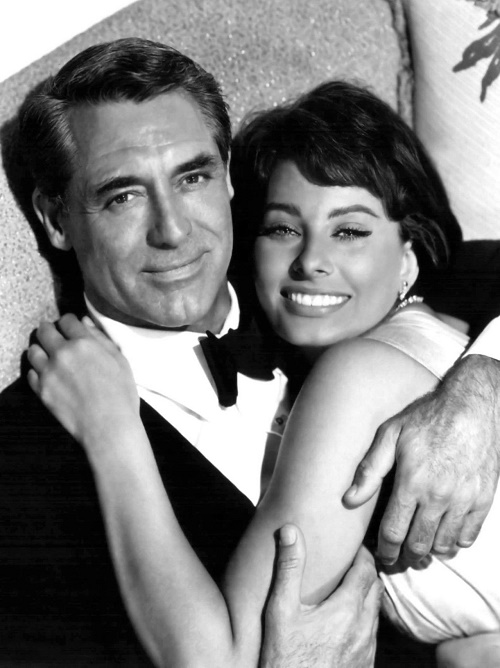
Sophia Loren et Cary Grant partagent la vedette du film La Péniche du bonheur. L’épouse d’alors de Grant, Betsy Drake, en a écrit le scénario original et Grant souhaitait initialement que son épouse partage l’affiche avec lui. Mais, au cours du tournage du film précédent en 1957, Orgueil et Passion, une liaison était née entre Loren et Grant, et ce dernier s’était alors arrangé pour que Loren prenne la place de Drake dans le film suivant (La Péniche du bonheur), avec un scénario réécrit ne faisant plus référence à celui de Betsy Drake, son épouse. Néanmoins, la liaison entre Grant et Loren s’est terminée avant la fin du tournage d’Orgueil et Passion, créant des problèmes sur le plateau du film suivant. Grant espèrait pouvoir reprendre sa liaison avec Loren mais celle-ci a préfèré accepter la demande en mariage de Carlo Ponti.

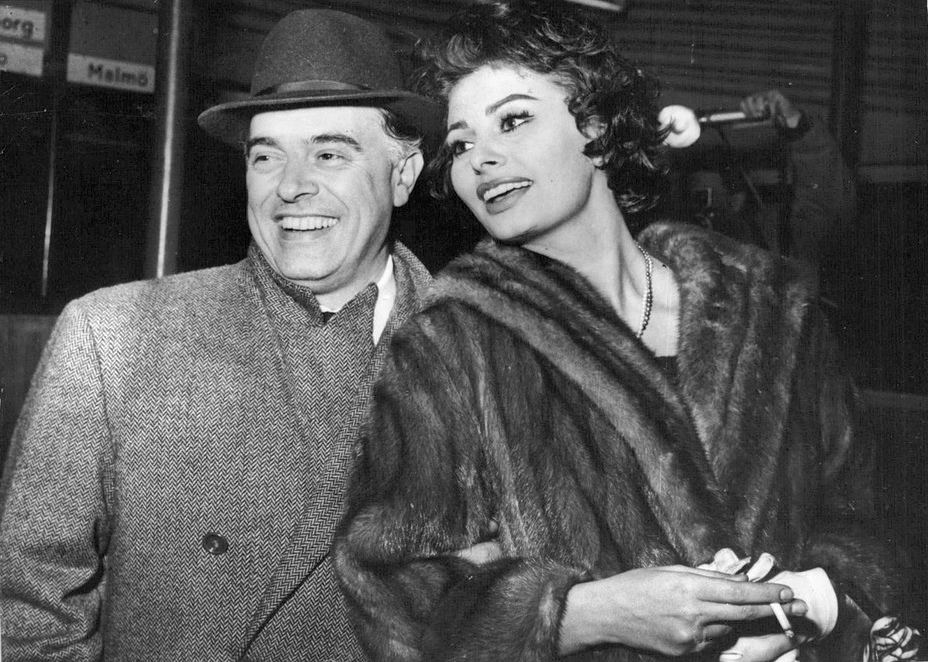
Sofia Villani Scicolone rencontre pour la première fois le producteur de cinéma italien Carlo Ponti (1912-2007) en 1950, alors qu’elle n’a que 16 ans et lui 37 : il est occasionnellement dans des jurys de concours de beauté ; il n’a ensuite cessé de guider le début de carrière de l’adolescente, puis de jeune femme, qui devient actrice.

Elle apparaît dans près d’une vingtaine de films au début des années 1950. L’ami de Ponti, Goffredo Lombardo, qui dirige la société de production Titanus, engage en 1952 la jeune Sofia dans Sous les mers d’Afrique et lui trouve le pseudonyme de « Sophia Loren ».

Carlo Ponti, qui est marié à Giuliana, et Sophia Loren finissent par se fréquenter dans le plus grand secret.

Elle devient une vedette internationale. Sept ans après sa première rencontre avec Loren, Ponti obtient un divorce au Mexique , séparé ainsi de sa première épouse, il se marie avec Loren par procuration, toujours au Mexique le 17 septembre 1957 : deux avocats les représentent.

Mais ce mariage est annulé en Italie en raison du non-enregistrement du divorce de Carlo Ponti d’avec Giuliana. Ponti et Loren continuent à vivre ensemble, mais ils sont dans l’illégalité dans leur propre pays, l’Italie, où les lois sont encore largement dictées par la tradition catholique : ils demandent la nationalité française, ce qui leur est accordé par le Premier ministre français de l’époque, Georges Pompidou. En 1965, Ponti régularise son divorce en France et peut cette fois épouser Loren dans les formes, le 9 avril 1966, soit près de neuf ans après le premier mariage annulé.

Le couple aura deux fils : Carlo Jr.  né en 1968, et Edoardo né en 1973.

Sophia Loren restera mariée à Carlo Ponti jusqu’à sa mort, 10 janvier 2007, d’une infection pulmonaire

Sources : Wikipedia / Pinterest / YouTube / Divers

  1. Unknown's avatar
  2. radiosatellite.co's avatar
  3. radiosatellite.co's avatar
  4. radiosatellite.co's avatar
  5. radiosatellite.co's avatar

AUTRES ARTICLES

https://radiosatellite.eu/artists/jason-kearney

https://radiosatellite.eu/artists/rene-de-roo

SOPHIA LOREN


sofia loren 1

Sofia Villani Scicolone born 20 September 1934), known professionally as Sophia Loren is an Italian film actress and singer. She is one of the last surviving stars from the Golden Age of Hollywood.

Encouraged to enroll in acting lessons after entering a beauty pageant, Loren began her film career at age 16 in 1950. She appeared in several bit parts and minor roles in the early part of the decade, until her five-picture contract with Paramount in 1956 launched her international career. Notable film appearances around this time include The Pride and the Passion, Houseboat, and It Started in Naples.

Her talents as an actress were not recognized until her performance as Cesira in Vittorio De Sica’s Two Women (1961); Loren’s performance earned her the Academy Award for Best Actress, making her the first thespian to win an Oscar for a foreign-language performance.

She holds the record for having earned six David di Donatello Awards for Best Actress: Two Women; Yesterday, Today and Tomorrow (1963); Marriage Italian Style (1964) (for which she was nominated for a second Oscar); Sunflower (1970); The Voyage (1974); and A Special Day (1977).

After starting a family in the early 1970s, Loren chose to make only occasional film appearances. Most recently, she has appeared in American films such as Grumpier Old Men (1995) and Nine (2009).

Aside from the Academy Award, she has won a Grammy Award, five special Golden Globes (including the Cecil B. DeMille Award), a BAFTA Award, a Laurel Award, the Volpi Cup for Best Actress at the Venice Film Festival, the Best Actress Award at the Cannes Film Festival and the Honorary Academy Award in 1991.

In 1995, she received the Golden Globe Cecil B. DeMille Award for lifetime achievements, one of many such awards. In 1999, Loren was named by the American Film Institute the 21st greatest female star of Classic Hollywood Cinema, and she is currently the only living actress on the list.

Sofia Villani Scicolone was born on 20 September 1934 in the Clinica Regina Margherita in Rome, Italy,  the daughter of Romilda Villani (1910–1991) and Riccardo Scicolone, a construction engineer of noble descent (Loren wrote in her autobiography that she is entitled to call herself the Marquess of Licata Scicolone Murillo).

Loren’s father Riccardo Scicolone refused to marry Villani,  leaving the piano teacher and aspiring actress without financial support. Loren met with her father three times, at age five, age seventeen and in 1976 at his deathbed, citing that she forgave him but had never forgotten the abandonment of her mother.

Loren’s parents had another child together, her sister Maria, in 1938. Loren has two younger paternal half-brothers, Giuliano and Giuseppe. Romilda, Sofia, and Maria lived with Loren’s grandmother in Pozzuoli, near Naples.

This slideshow requires JavaScript.

During the Second World War, the harbour and munitions plant in Pozzuoli was a frequent bombing target of the Allies. During one raid, as Loren ran to the shelter, she was struck by shrapnel and wounded in the chin. After that, the family moved to Naples, where they were taken in by distant relatives.

After the war, Loren and her family returned to Pozzuoli. Loren’s grandmother Luisa opened a pub in their living room, selling homemade cherry liquor. Romilda Villani played the piano, Maria sang, and Loren waited on tables and washed dishes. The place was popular with the American GIs stationed nearby.

At age 15, Loren as Sofia Lazzaro entered the Miss Italia 1950 beauty pageant and was assigned as Candidate #2, being one to the four sharing contestants representing the Lazio region.

She was selected as one of the last three finalists and won the title of “Miss Elegance 1950” , while Liliana Cardinale won the title of “Miss Cinema” and Anna Maria Bugliari won the grand title of Miss Italia. She returned in 2001 as president of the jury for the 61st edition of the pageant. In 2010, Loren crowned the 71st Miss Italia pageant winner.

1951–1953 as Sofia Scicolone, and as Sofia Lazzaro

At age 17, as Sofia Lazzaro, she enrolled in acting class and was selected as an uncredited extra in Mervyn LeRoy’s 1951 film Quo Vadis (1951), filmed when she was 17 years old.

That same year, she appeared in Italian film Era lui… sì! sì!, where she played an odalisque, and was credited as Sofia Lazzaro. She appeared in several bit parts and minor roles in the early part of the decade, including the La Favorita (1952).

Carlo Ponti changed her name and public image to appeal to a wider audience as Sophia Loren, being a twist on the name of the Swedish actress Märta Torén and suggested by Goffredo Lombardo. Her first starring role was in Aida (1953), for which she received critical acclaim.

After playing the lead role in Two Nights with Cleopatra (1953), her breakthrough role was in The Gold of Naples (1954), directed by Vittorio De Sica. Too Bad She’s Bad, also released in 1954, and (La Bella Mugnaia) (1955) became the first of many films in which Loren co-starred with Marcello Mastroianni.

Over the next three years, she acted in many films, including Scandal in Sorrento, Lucky to Be a Woman, Boy on a Dolphin, Legend of the Lost and The Pride and the Passion.

Loren became an international film star following her five-picture contract with Paramount Pictures in 1958.

Among her films at this time were Desire Under the Elms with Anthony Perkins, based upon the Eugene O’Neill play; Houseboat, a romantic comedy co-starring Cary Grant; and George Cukor’s Heller in Pink Tights, in which she appeared as a blonde for the first time.

In 1960, she starred in Vittorio De Sica’s Two Women, a stark, gritty story of a mother who is trying to protect her 12-year-old daughter in war-torn Italy.

The two end up gang-raped inside a church as they travel back to their home city following cessation of bombings there.

Originally cast as the daughter, Loren fought against type and was eventually cast as the mother (actress Eleonora Brown would portray the daughter). Loren’s performance earned her many awards, including the Cannes Film Festival’s best performance prize, and an Academy Award for Best Actress, the first major Academy Award for a non-English-language performance or to an Italian actress.

She won 22 international awards for Two Women. The film was extremely well received by critics and a huge commercial success.

Though proud of this accomplishment, Loren did not show up to this award, citing fear of fainting at the award ceremony.

Nevertheless, Cary Grant telephoned her in Rome the next day to inform her of the Oscar award.[citation needed]

During the 1960s, Loren was one of the most popular actresses in the world, and continued to make films in the United States and Europe, starring with prominent leading men. In 1964, her career reached its pinnacle when she received $1 million to appear in The Fall of the Roman Empire.

In 1965, she received a second Academy Award nomination for her performance in Marriage Italian-Style.

Drawing of Loren by Nicholas Volpe after she won an Oscar for Two Women (1961)

Among Loren’s best-known films of this period are Samuel Bronston’s epic production of El Cid (1961) with Charlton Heston, The Millionairess (1960) with Peter Sellers,

It Started in Naples (1960) with Clark Gable, Vittorio De Sica’s triptych Yesterday,

Today and Tomorrow (1963) with Marcello Mastroianni,

Peter Ustinov’s Lady L (1965) with Paul Newman,

the 1966 classic Arabesque with Gregory Peck, and Charlie Chaplin’s final film

, A Countess from Hong Kong (1967) with Marlon Brando.

Loren received four Golden Globe Awards between 1964 and 1977 as “World Film Favorite – Female”

1970–1988

Loren worked less after becoming a mother. During the next decade, most of her roles were in Italian features.

During the 1970s, she was paired with Richard Burton in the last De Sica-directed film, The Voyage (1974), and a remake of the film Brief Encounter (1974).

The film had its premiere on US television on 12 November 1974 as part of the Hallmark Hall of Fame series on NBC. In 1976, she starred in The Cassandra Crossing.

It fared extremely well internationally, and was a respectable box office success in US market.

She co-starred with Marcello Mastroianni in Ettore Scola’s A Special Day (1977). This movie was nominated for 11 international awards such as two Oscars (best actor in leading role, best foreign picture).

It won a Golden Globe Award and a César Award for best foreign movie. Loren’s performance was awarded with a David di Donatello Award, the seventh in her career. The movie was extremely well received by American reviewers and became a box office hit.

Following this success, Loren starred in an American thriller Brass Target.

This movie received mixed reviews, although it was moderately successful in the United States and internationally.

In 1978, she won her fourth Golden Globe for “world film favorite”.

Other movies of this decade were Academy award nominee Sunflower (1970), which was a critical success, and Arthur Hiller’s Man of La Mancha (1972), which was a critical and commercial failure despite being nominated for several awards, including two Golden Globes. O’Toole and James Coco were nominated for two NBR awards, in addition the NBR listed Man of La Mancha in its best ten pictures of 1972 list.

In 1980, after the international success of the biography Sophia Loren: Living and Loving, Her Own Story by A. Hotchner, Loren portrayed herself and her mother in a made-for-television biopic adaptation of her autobiography, Sophia Loren: Her Own Story. Ritza Brown and Chiara Ferrari each portrayed the younger Loren.

In 1981, she became the first female celebrity to launch her own perfume, ‘Sophia’, and a brand of eyewear soon followed.

In 1982, while in Italy, she made headlines after serving an 18-day prison sentence on tax evasion charges – a fact that failed to hamper her popularity or career.

In fact, Bill Moore, then employed at Pickle Packers International advertising department, sent her a pink pickle-shaped trophy for being “the prettiest lady in the prettiest pickle”. In 2013, the supreme court of Italy cleared her of the charges.

She acted infrequently during the 1980s and in 1981 turned down the role of Alexis Carrington in the television series Dynasty.

Although she was set to star in 13 episodes of CBS’s Falcon Crest in 1984 as Angela Channing’s half-sister Francesca Gioberti, negotiations fell through at the last moment and the role went to Gina Lollobrigida instead. Loren preferred devoting more time to raising her sons.

sophia loren2

Later career

In 1991, Loren received the Academy Honorary Award for her contributions to world cinema and was declared “one of the world cinema’s treasures”. In 1995, she received the Golden Globe Cecil B. DeMille Award.

She presented Federico Fellini with his honorary Oscar in April 1993. In 2009, Loren stated on Larry King Live that Fellini had planned to direct her in a film shortly before his death in 1993.

Throughout the 1990s and 2000s, Loren was selective about choosing her films and ventured into various areas of business, including cookbooks, eyewear, jewelry, and perfume.

She received a Golden Globe nomination for her performance in Robert Altman’s film Ready to Wear (1994), co-starring Julia Roberts.

In 1994, a Golden Palm Star on the Palm Springs, California Walk of Stars was dedicated to her.

In Grumpier Old Men (1995), Loren played a femme fatale opposite Walter Matthau, Jack Lemmon, and Ann-Margret.

The film was a box-office success and became Loren’s biggest US hit in years.

At the 20th Moscow International Film Festival in 1997, she was awarded an Honorable Prize for contribution to cinema. In 1999, the American Film Institute named Loren among the greatest female stars of Golden Age of Hollywood cinema.

In 2001, Loren received a Special Grand Prix of the Americas Award at the Montreal World Film Festival for her body of work.She filmed two projects in Canada during this time: the independent film Between Strangers (2002), directed by her son Edoardo and co-starring Mira Sorvino, and the television miniseries Lives of the Saints (2004).

In 2009, after five years off the set and 14 years since she starred in a prominent US theatrical film, Loren starred in Rob Marshall’s film version of Nine, based on the Broadway musical that tells the story of a director whose midlife crisis causes him to struggle to complete his latest film;

he is forced to balance the influences of numerous formative women in his life, including his deceased mother. Loren was Marshall’s first and only choice for the role.

The film also stars Daniel Day-Lewis, Penélope Cruz, Kate Hudson, Marion Cotillard, and Nicole Kidman. As a part of the cast, she received her first nomination for a Screen Actors Guild Award.

In 2010, Loren played her own mother in a two-part Italian television miniseries about her early life, directed by Vittorio Sindoni with Margareth Madè as Loren, entitled La Mia Casa È Piena di Specchi , based on the memoir by her sister Maria.

In July 2013, Loren made her film comeback in an Italian adaptation of Jean Cocteau’s 1930 play The Human Voice (La Voce Umana), which charts the breakdown of a woman who is left by her lover – with her youngest son, Edoardo Ponti, as director.

Filming took under a month during July in various locations in Italy, including Rome and Naples. It was Loren’s first significant feature film since Nine.

Loren received a star on 16 November 2017, at Almeria Walk of Fame due to his intervention in Bianco, rosso e…. She received the Almería Tierra de Cine award.

In September 1999, Loren filed a lawsuit against 79 adult websites for posting altered nude photos of her on the internet.

Loren is a Roman Catholic. Her primary residence has been in Geneva, Switzerland, since late 2006. She also owns homes in Naples and Rome.

Loren is an ardent fan of the football club S.S.C. Napoli. In May 2007, when the team was third in Serie B, she (then age 72) told the Gazzetta dello Sport that she would do a striptease if the team won.

HOUSEBOAT MOVIE
HOUSEBOAT MOVIE

Affair with Cary Grant

Loren and Cary Grant co-starred in Houseboat (1958). Grant’s wife Betsy Drake wrote the original script, and Grant originally intended that she would star with him.

After he began an affair with Loren while filming The Pride and the Passion (1957), Grant arranged for Loren to take Drake’s place with a rewritten script for which Drake did not receive credit.

The affair ended in bitterness before The Pride and the Passion’s filming ended, causing problems on the Houseboat set.

Grant hoped to resume the relationship, but Loren agreed to marry Carlo Ponti, instead.

Marriage and family

Loren first met Ponti in 1950, when she was 16 and he was 37.

Though Ponti had been long separated from his first wife, Giuliana, he was not legally divorced when Loren married him by proxy (two male lawyers stood in for them) in Mexico on 17 September 1957.

The couple had their marriage annulled in 1962 to escape bigamy charges, but continued to live together.

In 1965, they became French citizens after their application was approved by then French President Georges Pompidou. Ponti then obtained a divorce from Giuliana in France, allowing him to marry Loren on 9 April 1966.

They had two children, Carlo Ponti Jr., born on 29 December 1968, and Edoardo Ponti, born on 6 January 1973.Loren’s daughters-in-law are Sasha Alexander and Andrea Meszaros. Loren has four grandchildren. Loren remained married to Carlo Ponti until his death on 10 January 2007 of pulmonary complications.

sophia loren and Carlo Ponti

In 1962, Loren’s sister Maria married the youngest son of Benito Mussolini, Romano, with whom she had two daughters, Alessandra, a national conservative Italian politician, and Elisabetta.

  • Click and Listen

Sophia Loren sur radiosatellite.online


Nous reprenons notre article sur

https://radiosatellite.online


https://radiosatellite.online/lire?id=38

Marietto and Sophia Loren
ClarK Gable Sophia Loren in “It started in Naples”